




£25 OFF selected EV charger installations, FREE Salus EV7UK offer & much more
Shop Now


Power cuts can interrupt far more than just your lighting. Internet routers, refrigerators, freezers, laptops, medical equipment and smartphones can all become difficult or even impossible to use when the mains supply fails. A portable power station provides a quiet, rechargeable source of backup electricity that can keep selected appliances and devices running until grid power returns to normal.
Unlike a petrol or diesel generator, a portable power station stores electricity in an internal battery and supplies it through standard AC sockets, USB ports and many other useful outputs. It produces no exhaust fumes at the point of use and requires no fuel to operate. A suitable model can be used safely indoors in accordance with the manufacturer's instructions. Most units can be recharged easily from a standard 3-pin wall socket, while many portable power stations also support solar panel and even vehicle charging.
However, not every portable power station is equally well-suited to emergency home backup...
Small models are great for charging phones, tablets and lights, but may not have enough battery capacity or AC output to run appliances such as refrigerators, microwaves, kettles or pumps. The best choice depends on what you need to power, how much electricity those devices use and how long the power outage is likely to last.
For power cuts, battery capacity and continuous AC output are two of the most important specifications. Capacity - measured in watt-hours (Wh) - influences how long the portable power station can run your equipment. Continuous output - measured in watts (W) - determines which appliances it can operate at the same time. Both figures must be considered together because a large battery is of limited value if its inverter cannot supply the required load. Expansion batteries can also offer longer runtimes without requiring you to replace the main unit, providing you purchase the right model.
In this guide, Eco Wizard explains what makes a portable power station suitable for a power cut and compares five of the strongest options in our range. For broader help with capacity, output, charging methods and everyday uses, see our Complete Guide To Portable Power Stations.
When a fault occurs and voltage drops to zero, a portable power station can keep essential equipment running without the mechanical noise and exhaust emissions associated with a combustion generator. Portable power stations use lithium-ion or lithium iron phosphate (LiFePO4) batteries for their long lifespan, near-silent operation, impressive energy density and superior safety. Your portable power unit can therefore be easily charged up beforehand, stored away ready for use, and then moved to a room where power is needed during an outage.
Models with multiple AC and USB outputs can support several compatible devices at once, provided their combined demand remains within the unit's rated output.
This flexibility is especially useful during short-term and medium-length outages. A portable power station may keep a refrigerator cold, maintain an internet connection, recharge phones and provide lighting while the mains supply is unavailable. Higher-capacity models can even run selected cooking appliances, pumps, televisions, computers and other equipment, but actual runtime will depend on individual appliance consumption and how frequently it operates.
Key reasons to choose a portable power station for power cuts:
Our Complete Guide To Portable Power Stations will help streamline the decision-making process before you purchase your very own portable power unit. Explore everything from battery capacity and charging speeds to common buying mistakes, customer FAQs and much more.
The best portable power station for your home is not necessarily the model with the largest battery or the highest output. It should have enough capacity for your desired runtime, enough continuous power for the appliances you intend to connect, and the correct outputs for those devices. Weight, charging speed, UPS performance and expansion options can also affect which model offers the best long-term value for you.
The five models below cover different levels of backup power, from compact power cut support for household essentials to a scalable system that deals with longer and more demanding outages. All use long-life LiFePO₄ battery chemistry and provide UPS functionality, but their capacity, output and expandability vary significantly.
Best for high-capacity, expandable home backup.
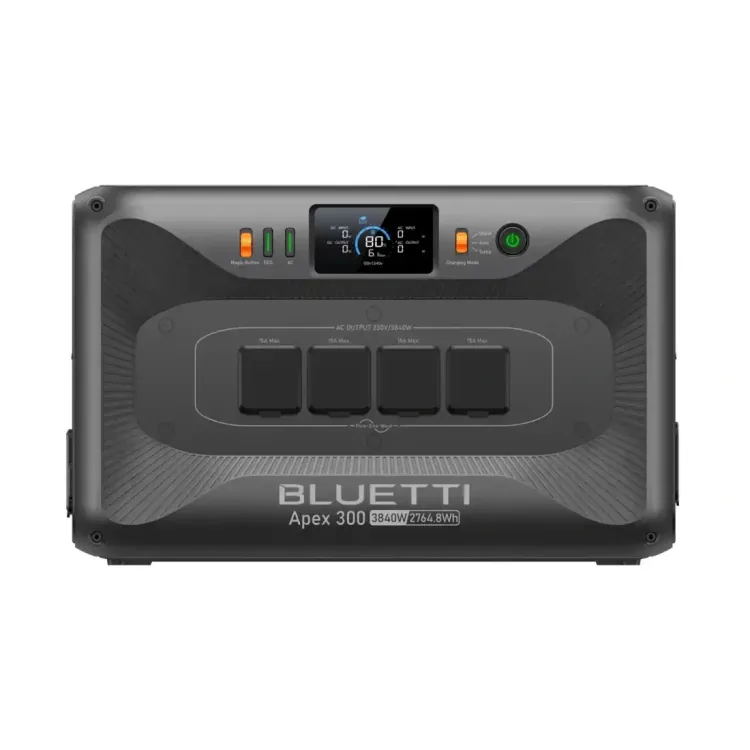
The BLUETTI Apex 300 Portable Power Station is the strongest option here for households that want substantial power now and extensive room to expand later.
Its approximately 2,764Wh battery and 3,800W AC output can support a wide selection of essential and high-demand appliances, while four AC sockets allow several compatible loads to be connected. A surge rating above its continuous output also helps it start appliances with motors or compressors, provided their requirements remain within the manufacturer's limits.
However, its main advantage is scalability. Compatible BLUETTI expansion batteries and system components can increase storage to as much as 58kWh and output to 11.52kW in a supported configuration. The automotive-grade LiFePO₄ battery is designed for long service, while UPS functionality switches in approximately 20ms. At 38kg, it isn't ideal for carrying around compared to the smaller models in this guide. But its capacity, output and expansion potential make it the best choice for prolonged power outages and more comprehensive home backup.
Best all-round portable power station for power cuts.
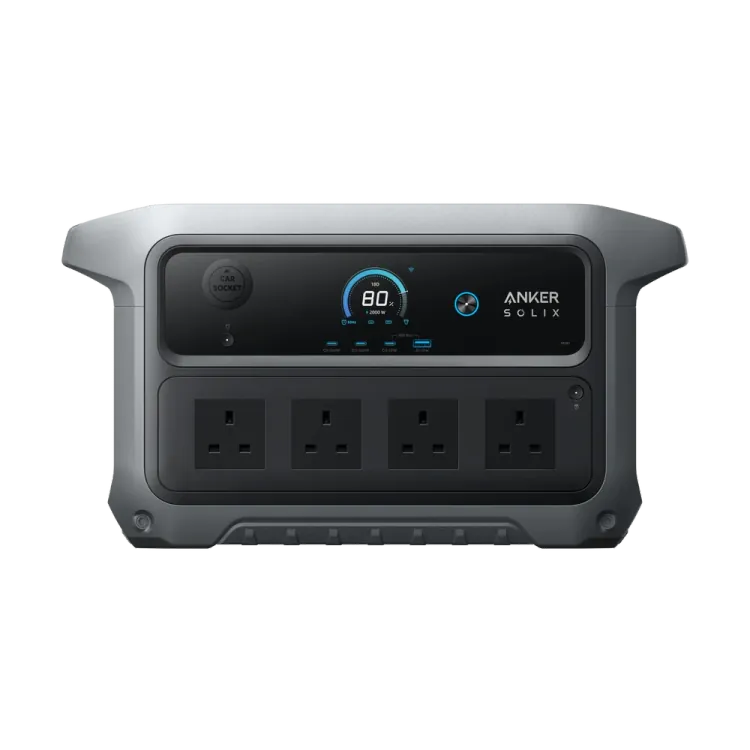
The Anker SOLIX C2000 Gen 2 Portable Power Station balances capacity, output, portability and charging speed particularly well.
Its 2,048Wh LiFePO₄ battery and 2,400W continuous output are suitable for refrigerators, routers, televisions, computers and many kitchen or household appliances. The inverter can deliver up to 4,000W peak power, while four AC outlets and a selection of USB and DC connections make it practical for supporting several essentials together.
During an outage, its 10ms UPS switchover can help keep compatible devices operating when the mains supply fails. The battery is rated for 4,000 cycles before retaining 80% of its original capacity, and an optional Anker SOLIX BP2000 Gen 2 expansion battery increases total storage to 4,096Wh. It can also recharge from empty in as little as 58 minutes using combined AC and solar input. At approximately 18.9kg, it provides considerably more energy than a typical 1kWh unit while remaining manageable enough to carry around and reposition in the home.
Best for powerful 2kWh backup without expansion.
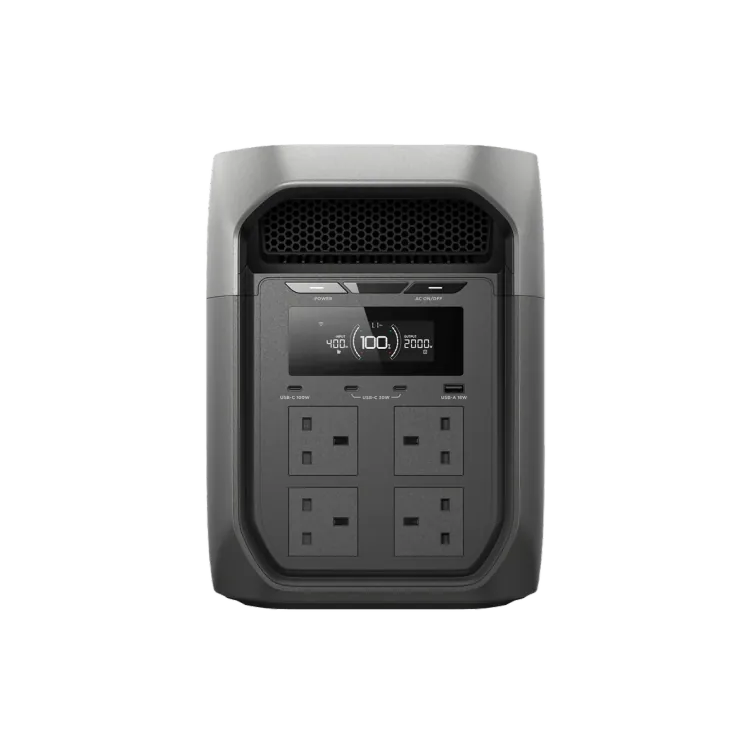
The EcoFlow DELTA 3 Max combines a 2,048Wh LiFePO₄ battery with 2,400W of continuous AC output and 4,800W surge power. This gives it the capacity and inverter strength required to run a useful combination of home essentials, while X-Boost can support selected compatible resistive appliances rated up to 3,200W. Four UK AC outlets, USB connections and a 12V car outlet provide flexible power for appliances and electronics.
Its 10ms UPS switchover is ideal for compatible equipment that needs continuity during a blackout, and mains charging can replenish the battery in approximately 68 minutes. EcoFlow rates the LFP battery for 4,000 cycles to 80% capacity, supporting many years of occasional emergency use. It is important to distinguish the standard DELTA 3 Max from the DELTA 3 Max Plus: this model does not have an extra-battery port, so buyers wanting expandable storage should choose another option in this list.
Best for compact, expandable backup power.
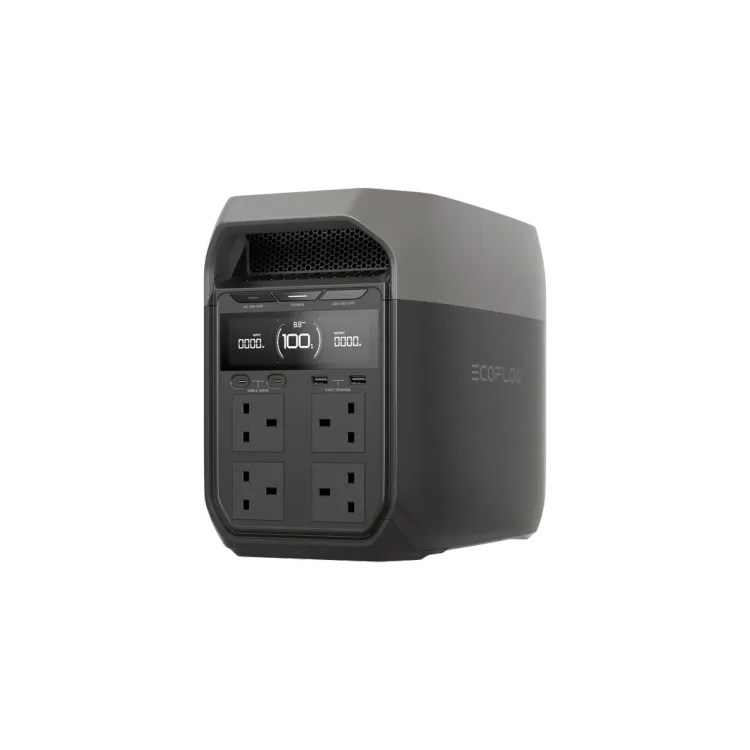
The EcoFlow DELTA 3 Plus is a versatile choice for households that want a more compact and portable unit without losing the option to increase runtime. Its 1,024Wh LiFePO₄ battery, 1,800W continuous pure sine wave output and 3,600W surge capability can handle internet equipment, televisions, lighting, computers, refrigeration and many other household essentials. At approximately 12.5kg, it is significantly easier to move than the larger 2kWh and 2.7kWh models.
A 10ms UPS mode helps maintain power to compatible equipment during a grid failure. The battery is rated to retain at least 80% capacity after 4,000 cycles, while a dedicated expansion port supports selected EcoFlow Smart Extra Batteries. This allows buyers to begin with a portable 1kWh system and add capacity if longer outages or higher energy use become a concern. Dual solar inputs support up to 1,000W in total, and mains charging can deliver a full recharge in approximately 56 minutes.
Best-value option for essential home equipment.
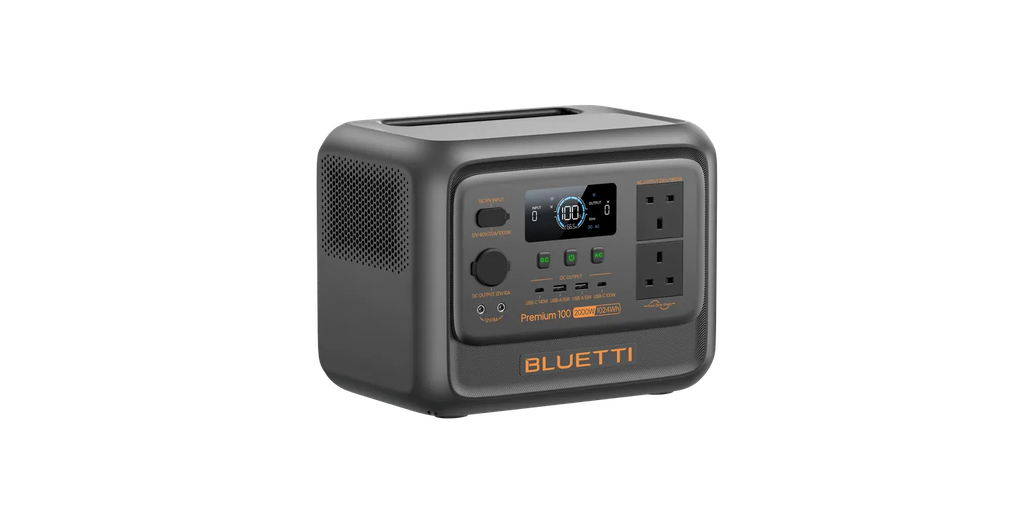
The BLUETTI Premium 100 V2 Portable Power Station is a compact 1,024Wh power station designed for lighter backup requirements. Its 1,800W continuous output and 3,600W surge capability make it suitable for keeping routers, phones, laptops, lighting, televisions and selected compact refrigeration units operating. Nine output ports provide a useful mix of AC, USB and DC connections, and the unit weighs approximately 11.5kg.
Its 10ms UPS switchover and LiFePO₄ battery make it a dependable choice for essential electronics. BLUETTI rates the battery for up to 4,000 charge cycles, and AC Turbo charging can reach 80% in approximately 45 minutes. Unlike the Apex 300, the Premium 100 V2 does not support an external expansion battery, so its 1,024Wh capacity is fixed. It is therefore best suited to shorter power outages, lower combined loads or buyers who prioritise portability and value over maximum runtime.
Unsure about how much capacity you need from your portable power unit? Our Complete Guide To Portable Power Stations will explain exactly how to calculate battery capacity according to your appliance or device type and wattage, as well as your practical day-to-day needs.
Choosing a model purely by its headline capacity can lead to disappointing results. A portable power station must be able to start and continuously run your intended appliances, provide enough stored energy for the likely outage duration and recharge quickly enough to be ready when needed. UPS performance and battery longevity also matter if the unit will remain connected to critical equipment or be used on a regular basis.
The five most important features to compare are:
Battery capacity is measured in watt-hours and indicates how much energy a portable power station can store. As a simple theoretical example, a 1,000Wh battery could supply a constant 100W load for 10 hours. Real-world runtime will be lower because the inverter and other electronics consume some energy, appliances vary their demand and manufacturers may reserve part of the battery to protect it.
A 1,024Wh model can be a practical choice for communications, lighting and selected refrigeration units during shorter outages. A 2,048Wh or larger unit provides more flexibility for multiple appliances or longer use. Start by listing the equipment you consider essential, checking its wattage and estimating how many hours it must operate. Always allow a safety margin rather than planning to use every available watt-hour.
Continuous AC output determines the combined load a power station can supply over time. A 1,800W model may run many everyday appliances, but several devices operating together can exceed that limit. Equipment containing motors, pumps or compressors may also demand a brief surge of power when starting, so both continuous and surge ratings need to be checked.
Do not assume that a high surge figure means the portable power station can continuously operate an appliance at that wattage. Modes such as EcoFlow X-Boost or BLUETTI Power Lifting are intended for certain compatible loads and do not increase the inverter's normal continuous rating. Check the appliance label or manual, include the demand of every connected device and keep the total within the manufacturer's stated limits.
A portable power station with UPS (Uninterruptible Power Supply) functionality can sit between a wall socket and compatible equipment. Under normal conditions, grid electricity passes through to the connected devices. If the mains supply fails, the unit switches to battery power automatically, reducing or avoiding interruption.
Transfer time matters because sensitive electronics can shut down if power is absent for too long. The Anker SOLIX C2000 Gen 2, EcoFlow DELTA 3 Max, EcoFlow DELTA 3 Plus and BLUETTI Premium 100 V2 offer 10ms transfer times, while the BLUETTI Apex 300 switches in approximately 20ms.
Please note, compatibility still depends on your connected equipment, and a portable power station should not be treated as a substitute for a medically certified or specialist online UPS where uninterrupted operation is safety-critical.
Lithium iron phosphate - usually written as LiFePO₄ or LFP - is ideal for backup power because it provides strong thermal stability and a long cycle life. Our shortlisted models are rated for thousands of cycles, meaning they should retain useful capacity after many years of occasional outages, routine charging and off-grid use.
Cycle ratings are normally measured until the battery falls to a stated proportion of its original capacity, often 80%. Reaching that point does not mean the battery immediately stops working, but its available runtime will be lower than when originally purchased. Storage temperature, charging habits, discharge depth and load can all affect long-term performance. Follow the manufacturer's guidance and check the battery periodically rather than leaving it stored away for years.
An expansion battery allows you to increase runtime while continuing to use the same main portable power station and inverter. This can be valuable if you initially need backup for short outages but want the option to support more appliances, or prepare for longer interruptions later. It also lets you separate the additional battery for easier transport on compatible modular systems.
Expandability varies widely. The BLUETTI Apex 300 offers the greatest scaling potential in this selection, the Anker SOLIX C2000 Gen 2 can double from 2,048Wh to 4,096Wh and the EcoFlow DELTA 3 Plus accepts selected EcoFlow Smart Extra Batteries. The standard EcoFlow DELTA 3 Max and BLUETTI Premium 100 V2 have fixed capacities, so buyers who expect their backup requirements to grow should account for this before purchasing.
If your mind is still surging with questions, our Complete Guide To Portable Power Stations unpacks even more of the functions and features connected to emergency backup power. Once you've made a decision, visit our Portable Power Station collection to complete your journey with Eco Wizard today.