




£25 OFF selected EV charger installations, FREE Salus EV7UK offer & much more
Shop Now


Once bought mainly for camping, the portable power stations of today have grown far beyond their roots. Smaller models can keep phones, laptops and lights powered, while larger units can run televisions, refrigerators and even selected power tools. This flexibility makes them useful for power cuts, remote working, motorhomes, caravans and time spent off-grid.
The portable power market has evolved quickly, with advances in battery technology, charging and power management. Many current models use long-life LiFePO₄ batteries and support fast mains charging, while selected units offer portable solar panel charging, app control, UPS functions or expandable storage. These innovative features give buyers more choice over how they charge, use and manage their power.
However, more choice also means more technical terminology to understand...
Battery capacity is measured in watt-hours, output is measured in watts, surge ratings are not the same as continuous power and the number of sockets tells you very little about what a unit can actually run. Two power stations that look very similar can perform very differently once efficiency, charging speed, solar input, battery chemistry and appliance starting power are taken into account.
Choosing the right portable power station is therefore not simply about buying the model with the largest battery. It is about matching usable capacity, output and charging options to the way you expect to use it. Get that balance right and you gain quiet, convenient power that can travel with you or support essential devices during an outage. Get it wrong and you may pay for capacity you cannot comfortably carry, or discover that an important appliance exceeds the unit’s output when you need it most.
In this guide, Eco Wizard will take you on a journey through the portable power station landscape. We'll unpack everything from battery capacity and output to charging methods, solar compatibility and key features, helping you choose a model that suits how and where you plan to use it.
A portable power station is a rechargeable battery system that stores electrical energy and supplies it through an array of outputs. Think of it like a larger, more versatile power bank: you charge it in advance, then use its stored energy to power suitable devices when you need them. Most models combine a lithium battery, battery management system, inverter, charging electronics, display and connection ports in one enclosed unit. This allows compatible mains appliances and low-voltage devices to be powered without a fuel-driven generator or permanent electrical installation.
The inverter is a particularly important component. Batteries store direct current, known as DC, while standard UK household appliances normally use alternating current, or AC. The inverter converts stored DC electricity into AC electricity for the unit’s three-pin sockets. USB and dedicated DC outputs can supply compatible devices more directly, often avoiding some of the conversion losses associated with running the inverter.
Unlike a small power bank, a portable power station usually provides much greater storage capacity and a broader selection of useful outputs. Depending on the model, these may include UK AC sockets, USB-A, high-power USB-C, 12V car outlets and specialist DC connections. Larger systems may also accept expansion batteries or integrate with higher-power vehicle and solar charging equipment.
A portable power station is also different from a petrol or diesel generator. It does not generate electricity by burning fuel. Instead, it stores energy supplied through the mains, compatible solar panels or another supported charging source. This makes it quieter, easier to use indoors and free from exhaust fumes during normal operation - although the battery will eventually need to be recharged.
The main benefits of portable power stations:
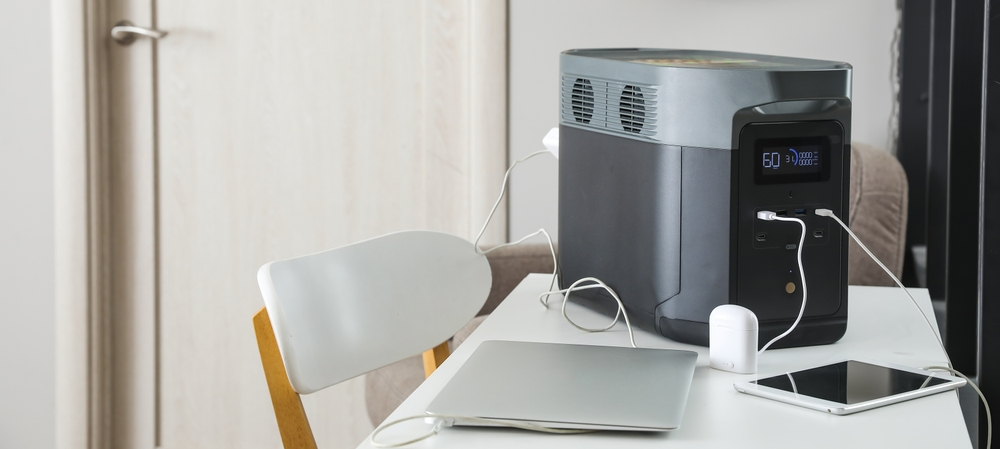
Portable power stations are ideal for situations where a normal mains socket is unavailable, inconvenient or temporarily out of service. The right model can provide anything from a few phone charges during a day outdoors to several hours of crucial backup electricity for important household appliances.
For camping, festivals and day trips, smaller models can keep smartphones, cameras, speakers, lights, laptops and portable coolers running without the noise of a generator. Their usefulness depends as much on weight and physical size as battery capacity, particularly if the unit must be carried any significant distance.
Motorhome, caravan and campervan users often need more capacity and a wider choice of connections. A suitable power station can support lighting, portable refrigeration, televisions, laptops, water pumps and other compatible travel equipment. Solar and vehicle charging can then replenish the battery while travelling or staying away from a mains hook-up. Portable power stations can also support remote work, mobile businesses, photography, filming, outdoor events and certain power tools.
Higher-powered equipment requires careful checking because tools containing motors may have a significant starting surge, even when their normal running wattage appears to be within the power station’s limit.
At home, a portable power station can keep selected essentials available during a power cut. Rather than attempting to power everything, most households will achieve longer and more useful runtime by prioritising WiFi equipment, phones, laptops, lighting and essential refrigeration.
Common portable power station applications include:
The numbers on a portable power station are easier to understand when you ask two questions: What can it run, and for how long? Output tells you what it can run. Capacity helps you estimate how long it will last.
Capacity is the energy stored in the battery, measured in watt-hours (Wh) or kilowatt-hours (kWh). Think of it as the size of the tank. Output is the power the station can deliver at one time, measured in watts (W). This is how quickly you can draw from that tank.
For example, a 1,024Wh battery will not run a 2,000W appliance unless the power station also has enough output to supply it. And if it can supply 2,000W, that appliance will use the stored energy quickly. At that rate, half an hour of use represents roughly 1,000Wh before conversion losses.
When comparing models, check the continuous output first. This is the power the station can supply steadily. Add up the running wattage of any AC appliances you plan to use at the same time. Their combined demand must stay within that rating, regardless of how many sockets the station has.
Then check the surge output. Fridges, pumps, compressors and some power tools can need an extra burst of power when they start. A station might handle their normal running demand but shut down if that initial surge is too high. Pay particular attention to kettles, fan heaters, hairdryers, microwaves and induction hobs. Their high power draw can rule out a lower-output model or use a large share of the battery in a short time.
The key specifications to understand:
The right battery capacity depends on what you want to power, how long it needs to run and how frequently you can recharge. Start by listing your essential devices, finding their wattage and estimating how many hours each one will operate.
Multiply the wattage of each device by the number of hours it will be used. A 60W appliance operating for five hours requires approximately 300Wh. A 10W light used over the same period adds another 50Wh, producing a combined requirement of around 350Wh before energy losses are included.
A basic runtime estimate can be calculated by dividing usable battery capacity by appliance wattage:
A 1,024Wh battery running a constant 100W appliance appears to offer just over ten hours on paper. In practice, the runtime will be lower because of inverter losses, standby consumption, temperature and the power station’s internal electronics. Appliance demand can also fluctuate, particularly with refrigerators, pumps and variable-speed tools.
For planning purposes, it is sensible to include a margin rather than assuming every advertised watt-hour will reach the appliance. Tested manufacturer runtimes can be useful, but the equipment, settings and conditions used in the test may differ from your own.
Capacity also has a direct effect on size, weight and price. The largest model is not necessarily the best if it is too heavy to move or provides substantially more energy than you will use. A compact power station may be better for regular day trips, while a wheeled or expandable system may suit longer off-grid stays and emergency backup.
A practical capacity guide:
Actual runtime and appliance compatibility depend on power consumption, conversion losses, and the station’s continuous and surge output. Check the specifications of both the power station and the equipment you intend to use.
One of the biggest advantages of a portable power station is the freedom to recharge it at home, on the road or wherever you can make use of the sun. Plug it into the mains before a trip, top it up from compatible solar panels while you are away, or use energy from your vehicle during a journey. Selected models at Eco Wizard offer even more options, including generator charging, faster vehicle charging or charging from two sources at once.
For a quick turnaround, mains charging is usually the easiest choice. Some models can recharge in as little as an hour for practical preparation between trips or to restore your backup supply after a power cut. Compare the manufacturer’s full recharge time when choosing a model, as the fastest quoted speed may require a particular charging setting.
You may not always want to charge at full speed. Models with adjustable mains charging let you lower the power draw, which can be useful at a campsite with a limited electrical supply. A slower setting may also reduce fan noise when charging nearby. On the road, a standard 12V vehicle outlet provides a convenient top-up, while compatible dedicated alternator chargers can charge supported systems much faster when correctly installed.
Compare the following charging details:
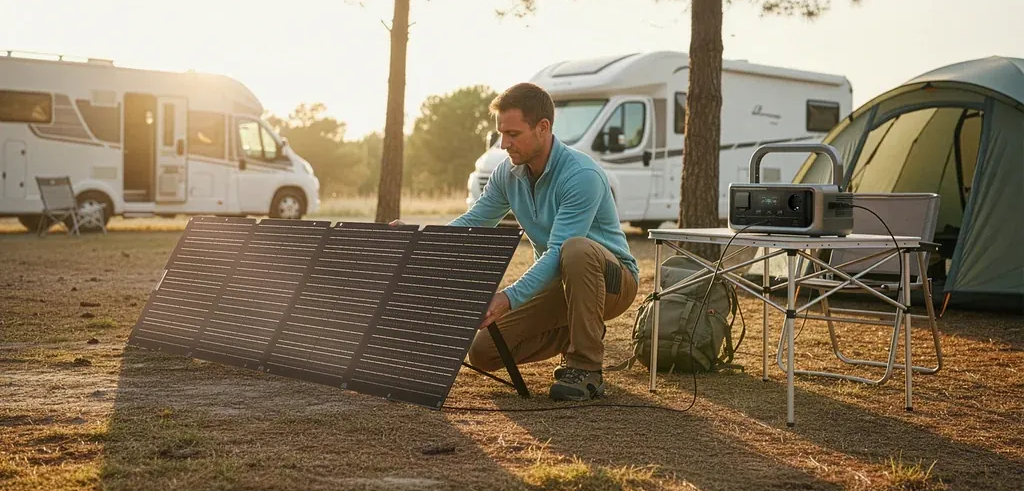
Pair your portable power station with portable solar panels and you can recharge it wherever there is suitable daylight. That means more time to run a camping fridge, keep a laptop charged or power essentials when the mains is unavailable. Place your solar panels where they receive direct sunlight - and away from trees, tents and other sources of shade. Angle them towards the sun and reposition them during the day to capture the most amount of natural light.
The appeal of solar charging is simple: the power station’s battery can be replenished while you are away. Set compatible panels in direct sunlight during the day and you can put energy back into the station without a mains connection or generator fuel. That extra charge can keep phones, laptops, lights or a camping fridge going for longer.
On models that support pass-through charging, your solar panels can recharge the power station’s battery while the station powers a plugged-in laptop or camping fridge, helping offset the energy you use during daylight.
How much extra energy you gain depends on the sunlight and your setup...
A 400W panel is rated for peak output under standard test conditions; it will produce less at other times. For the best result, keep it clear of shade, aim it towards the sun and check the power station’s maximum solar input when comparing models. A station that accepts more solar power gives you the option to use a larger compatible panel setup and recharge faster in suitable conditions.
For longer trips, the useful question is whether the panels can replace the energy you use each day. If your devices consume 800Wh and solar charging adds 800Wh, you could finish the day with roughly the same amount of stored energy, allowing for conversion losses and changes in sunlight. You can also use solar to extend a trip even when it does not replace every watt-hour you use.
For effective solar charging:
A portable power station is far more useful when you can recharge it regularly without worrying that the internal battery will soon wear out. That is a major reason many models now use lithium iron phosphate batteries - also known as LiFePO₄ or LFP. This modern battery chemistry is highly suited to frequent charging and discharging, with many LFP power stations rated to retain substantial capacity even after thousands of cycles.
LFP’s strong thermal stability also makes it less prone to thermal runaway than some other chemistries; an advantage for portable power stations charged and used regularly at home or on the move.
Cycle life gives you a way to judge that longevity. If a manufacturer quotes 3,000 cycles to 80%, it means the battery is expected to retain around 80% of its original capacity after 3,000 charge and discharge cycles under the stated test conditions. When comparing models, check both the cycle count and the remaining-capacity percentage, as different brands may use different test conditions.
Behind the scenes, a BMS (battery management system) monitors voltage, current and temperature. This helps to protect the station from problems such as overcharging, excessive discharge, short circuits and overloads. You may never interact with the BMS directly, but it plays an important part in keeping the battery operating within its intended limits. Always follow the manufacturer’s charging and operating instructions.
However, one of the biggest attractions of a portable power station is how much you can plug into a single unit. UK three-pin sockets can run your suitable appliances - from a camping fridge to a television or power tool. Versatile USB-C and USB-A ports make it easy to charge up phones, tablets and other everyday devices, while high-power USB slots can charge compatible laptops directly without taking up an AC socket. Many models also have 12V DC outputs that can power compatible camping and vehicle equipment directly, avoiding the energy losses involved in converting the power station’s stored energy to AC.
With the right mix of connections, one station can serve your devices at home, on the road and at your destination. Check the model’s total output if you plan to run several at once.
Features that provide practical value include:
When the power goes out, the first things you miss are often the simplest: the Wi-Fi router, a working laptop, lights and a way to charge your phone. A portable power station lets you keep the devices that matter most within reach during a power cut.
Selected models make power outage preparation even easier with a UPS (uninterruptible power supply) or emergency power supply function. In UPS mode, the power station sits between a wall socket and the equipment plugged into its AC outlets. It monitors the incoming mains supply and normally passes that power through to the connected devices. If the mains fails, the station automatically uses its inverter to supply AC electricity from its internal battery.
On suitable models, the switch to battery power takes just milliseconds, helping to keep your connected essentials running without having to lift a finger. Whether a router, desktop computer or other device stays on through that brief gap depends on its own power supply, so check compatibility if uninterrupted operation is essential. Some other equipment will require a dedicated UPS with zero transfer time.
You do not need to power the whole house for backup to make a difference. A router, phone, laptop and a few LED lights use far less energy than electric heating or cooking appliances, giving you a more practical way to stretch your stored up charge. Some stations can also run a fridge if their continuous and surge output can handle its compressor. Fridge runtime varies with its actual energy use and how often the compressor starts.
Get your backup setup ready:

The right power station should fit your plans now and leave room for what comes next. With an expandable model, you can start with the capacity you need today and add-on compatible extra batteries later if you want longer runtimes for trips or home backup. Extra batteries usually increase stored energy rather than the station’s output, so check what each expansion actually adds. They are designed for specific models or product families only, and the manufacturer’s approved combinations and capacity limits should guide your choice.
If you would prefer to choose several parts together, explore our portable power kits. Depending on the kit, these can bring together a power station or power system with suitable solar equipment and accessories. They offer a useful starting point for camping, motorhomes or longer stays off-grid. Check the contents of the particular kit so you know which panels, cables and other components are included.
Think about how you will move the station around as well. A compact model with a comfortable handle is appealing if you will carry it from the house to the car or around a campsite. A larger unit may offer far more runtime but be better suited to a fixed spot or a short journey on its built-in wheels. Check the weight and dimensions against where you intend to carry, use and store it.
Finally, match the unit to its surroundings. “Portable” does not automatically mean rainproof: check the exact model’s IP rating, operating temperatures and instructions before using it outdoors. Keep ventilation openings clear, use suitable charging equipment and follow the manufacturer’s storage guidance accordingly. Stop using a unit that is damaged, unusually hot or producing an unfamiliar smell or sound.
Important ownership considerations include:
Start with what you want to do - whether that is keeping a camping fridge running, working away from a socket or having essential devices and appliances ready for a power cut. The best portable power station is one that can run your devices for the time you need and in a size you can comfortably use.
From there, the specifications become much easier to compare: capacity affects runtime, output determines what you can run, and charging options determine how readily you can top it up.
Look at the whole package rather than the price or battery size alone. Two stations with similar watt-hour ratings may differ in AC output, charging speed, solar input, ports, weight and included accessories. A model that costs more may offer a feature you will use regularly, such as faster mains charging or room to expand with add-on batteries. Equally, there is little value in paying for capacity you will struggle to carry or functions you simply do not need.
Eco Wizard’s range gives you several ways to find that fit. EcoFlow spans compact RIVER stations and larger DELTA models, with compatible solar panels, charging accessories and expansion options across selected systems. Anker SOLIX power stations include compact DC-focused choices as well as larger models for more demanding uses. Bluetti provides options from lighter camping units to higher-capacity and expandable systems. Features vary by model, so compare the specifications that matter to you within each range.
You can also explore portable power from ALLPOWERS, Photonic Universe, Sherpa Power and V-TAC Energy. Keeping your intended devices and charging plans in mind will help you spot the right model across these brands.
Follow this process when choosing:
Even with the best intentions, buyers can still make avoidable mistakes when comparing portable power stations. These problems can result in insufficient runtime, incompatible appliances or a heavy and expensive product that does not suit its intended use.
Understanding the common pitfalls will help you focus on the specifications that provide genuine value.
The most common mistakes include:
There is no single best model for every user. The right power station provides enough usable capacity for your required runtime, sufficient continuous and surge output for your appliances, suitable charging options and a weight you can manage. EcoFlow, Anker SOLIX and Bluetti all offer an array of models across different capacity and output categories.
Multiply each device’s wattage by the number of hours you expect to use it, add the results together and include an allowance for conversion losses and additional demand. You must then confirm that the power station’s continuous and surge output can support the connected appliances.
Runtime depends on battery capacity, appliance wattage, inverter efficiency and operating conditions. Divide the estimated usable capacity in watt-hours by the average load in watts for a rough runtime. The product’s overall lifespan depends on battery chemistry, cycle life, temperature, storage and frequency of use.
A 1,000Wh power station can potentially run phones, laptops, lighting, televisions, Wi-Fi equipment, portable refrigeration and selected household appliances. The exact runtime depends on appliance consumption and system efficiency. Its inverter must also provide enough continuous and surge output for the equipment.
Many portable power stations can run a refrigerator, but the inverter must support both its normal running wattage and the higher starting surge produced by the compressor. Runtime depends on battery capacity, refrigerator efficiency, ambient temperature and how frequently the fridge door is opened.
Only if its continuous output supports the appliance. Kettles and electric heaters frequently draw between approximately 1,500W and 3,000W and can drain a battery extremely quickly. Even when a large power station can operate them, they may not represent an efficient use of limited stored energy.
Yes, provided the model supports solar charging and the connected panels remain within its permitted voltage, current and wattage limits. The correct cable and connector are also required. Actual recharge times vary according to weather, shade, season and panel positioning.
No, for the easiest setup, choose a portable solar panel that the manufacturer recommends for your exact power station. Whether you choose that panel or a third-party option, confirm its open-circuit voltage, operating voltage, current, wattage, connector and polarity against the station’s solar input specifications. A plug that fits does not, by itself, establish electrical compatibility
Portable battery power stations can generally be used indoors because they do not burn fuel or produce exhaust fumes during normal operation. They must still be kept dry, correctly ventilated and within the manufacturer’s operating-temperature limits. Do not cover the power station or obstruct its fans.
Only if the manufacturer specifies a UPS or emergency power supply function. Check the transfer time and compatibility with the equipment you want to protect. A portable power station should not automatically be treated as a replacement for a dedicated online UPS or used with critical medical equipment without manufacturer approval.
Most portable power stations are designed to power selected appliances directly rather than supply an entire property. Larger systems may support substantial loads, but any connection to fixed household wiring requires suitable changeover equipment and professional installation. Never feed electricity into household wiring through an ordinary socket.
Reputable products include a battery management system and electrical protections, but they must still be charged, used and stored correctly. Use approved cables, keep ventilation openings clear and protect the unit from water and extreme temperatures. Stop using it if it becomes damaged, swollen, unusually hot or produces smoke, an unfamiliar smell or abnormal sounds.
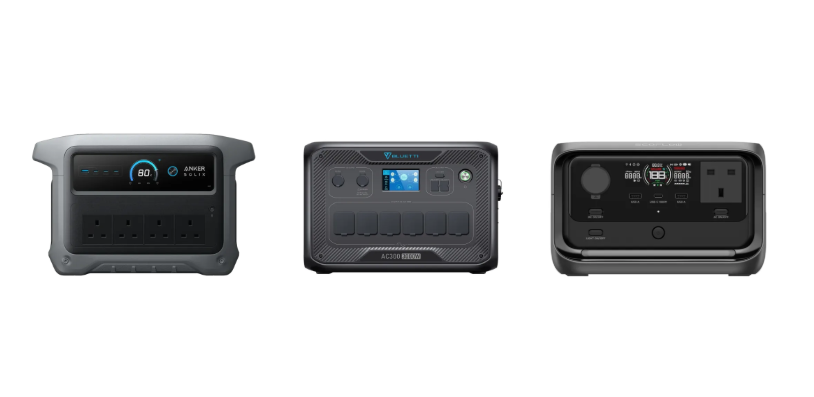
At Eco Wizard we offer a wide range of portable power stations to suit everything from weekend trips to home backup. Whether you need a compact model for charging everyday devices or a larger system for powering heftier appliances, you can explore a multitude of options with different battery capacities, outputs and charging methods to fit your needs.