




Our phone lines will close at 4:30pm today due to a scheduled system upgrade. You can still place orders as normal through our website.
Thank you for your understanding.


A home battery storage system can provide a reliable source of backup electricity when the mains supply fails, helping UK households keep essential appliances, lighting, refrigeration and communication equipment running during a power cut. Unlike portable backup devices, a properly configured home battery can be integrated into your property's electrical installation, allowing selected circuits or, in some cases, the entire home to receive electricity when grid power is unavailable.
For homeowners already considering solar panels or battery storage, emergency backup can be a valuable additional benefit. A suitable system can store electricity generated during the day or charge from the grid when electricity prices are lower, making that energy available for everyday household use or emergencies. Some systems can even recharge from compatible solar panels during an outage, extending the available backup time when conditions allow.
However, not every home battery storage system will continue supplying electricity during a power cut...
Many grid-connected batteries are designed primarily to reduce electricity bills, increase solar self-consumption and manage household energy demand. When the grid fails, these systems may automatically shut down unless they have the necessary backup functionality, switching equipment and electrical configuration. Simply having a fully charged battery does not guarantee that your appliances will continue operating.
Battery capacity is another important consideration. A 5kWh battery may provide several hours of electricity for essential equipment, but it cannot necessarily operate every appliance in your home. The battery's usable storage capacity, inverter output, connected circuits and household consumption all determine what can be powered and for how long.
In this guide, Eco Wizard explains how home battery storage works during power cuts, the differences between EPS and UPS functionality, what appliances a battery can support and how to calculate realistic backup runtimes. We'll also cover solar charging during outages, whole-home versus essential-circuit backup, installation requirements and the key features to consider before choosing a system.
If you're looking beyond the issue of power cuts, our Complete Guide To Home Battery Storage will explain how battery systems work and everything they can be used for, as well as battery capacity requirements, power outputs, AC vs DC coupled batteries and much more.
Yes, home battery storage can provide electricity during a power cut, but only when the system has been designed and installed with suitable backup capabilities.
Most grid-connected solar and battery installations operate alongside the public electricity network. During normal conditions, the battery can charge using surplus solar generation or electricity imported from the grid, then discharge when household demand increases.
However, when the mains supply fails, standard grid-connected inverters are generally required to disconnect from the network. This prevents electricity from being exported into power lines that may be undergoing maintenance or repairs.
A battery system without suitable backup functionality may therefore stop supplying electricity to the property, even if its battery is fully charged.
To continue operating during an outage, a compatible home battery system must be able to safely separate the supported household circuits from the public grid and provide an independent electricity supply.
This normally requires a backup-capable inverter and appropriate electrical switching arrangements. Depending on the equipment, backup operation may begin automatically or require manual activation.
Before purchasing a home battery for emergency use, always confirm that backup operation is supported by the complete system rather than assuming the battery or inverter provides this functionality automatically.
When a power cut occurs, a properly configured backup battery system detects the loss of the mains electricity supply and isolates its supported electrical circuits from the grid.
The inverter then uses electricity stored in the battery to supply those circuits, converting the battery's direct current (DC) electricity into alternating current (AC) suitable for compatible household appliances.
If the system supports automatic changeover, this process can happen without the homeowner needing to operate the equipment manually. However, there may still be a brief interruption while the system switches into backup mode.
Once backup operation begins, the battery continues supplying electricity until mains power returns, the battery reaches its permitted discharge limit or the connected electrical demand exceeds the system's capabilities.
For example, a household experiencing an evening power cut could continue using selected lighting circuits, its refrigerator, broadband router and television, provided these appliances are connected to the supported backup supply.
However, switching on a high-powered appliance could overload the backup inverter if the combined demand exceeds its rated output.
When grid electricity returns, the system can resume normal operation according to its design and settings, with the battery recharging from available solar generation or the grid.
The exact sequence varies between manufacturers, making it important to understand how your chosen system behaves before an unexpected outage occurs.
Emergency Power Supply (EPS) and Uninterruptible Power Supply (UPS) are two terms frequently associated with home battery backup. Although both relate to supplying electricity when mains power is unavailable, they describe different capabilities and should not be treated as interchangeable.
An Emergency Power Supply allows a compatible inverter and battery system to supply designated electrical loads when the grid fails.
Depending on the equipment, the EPS function may operate through a dedicated backup output, an automatic switching arrangement or a manually activated supply.
Some EPS systems switch to battery power within milliseconds, while others require a longer changeover period. This means connected appliances may experience a temporary interruption when the mains supply fails.
For lighting, refrigeration and many household appliances, a short interruption may be acceptable. However, computers, servers and other sensitive electronics could restart or shut down if the transfer takes too long.
A UPS is designed to maintain electrical power to connected equipment within its specified continuity or transfer requirements.
Some battery systems advertise UPS functionality because they can switch from grid electricity to battery power very quickly. However, a quoted transfer time does not automatically mean that the system provides the same protection as a dedicated online UPS.
Sensitive electronics may require a specific transfer time, output quality or continuous power arrangement to remain operational. For example, a desktop computer could shut down during a brief interruption that a refrigerator or television would tolerate without difficulty.
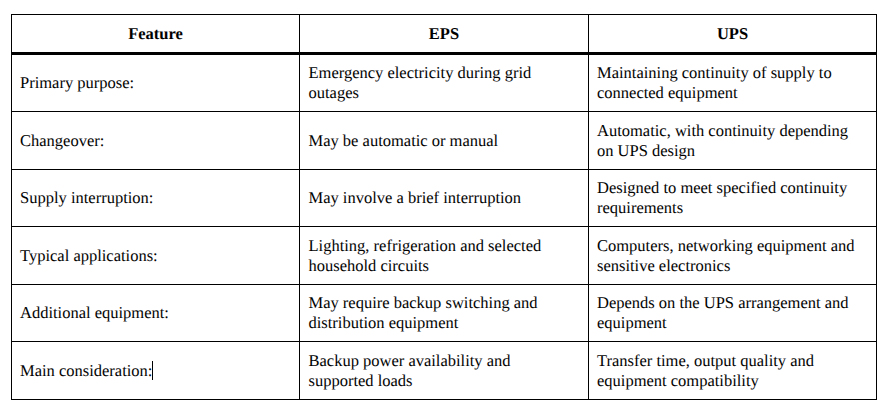
For homeowners primarily concerned with maintaining lighting, refrigeration and basic household services, an EPS-capable home battery may provide suitable backup.
Where uninterrupted operation is essential, check the manufacturer's technical specifications and consider whether a dedicated UPS is also required.
A home battery can operate a wide range of household appliances during a power cut, provided its inverter can supply their combined electrical demand and the appliances are connected to the supported backup circuits.
The most practical approach is usually to prioritise essential equipment rather than attempting to power everything in the property.
Refrigerators, freezers, internet routers, LED lighting, televisions and phone chargers generally have much lower energy requirements than electric showers, ovens or immersion heaters.
This makes them more suitable for battery backup, particularly when the outage lasts several hours.
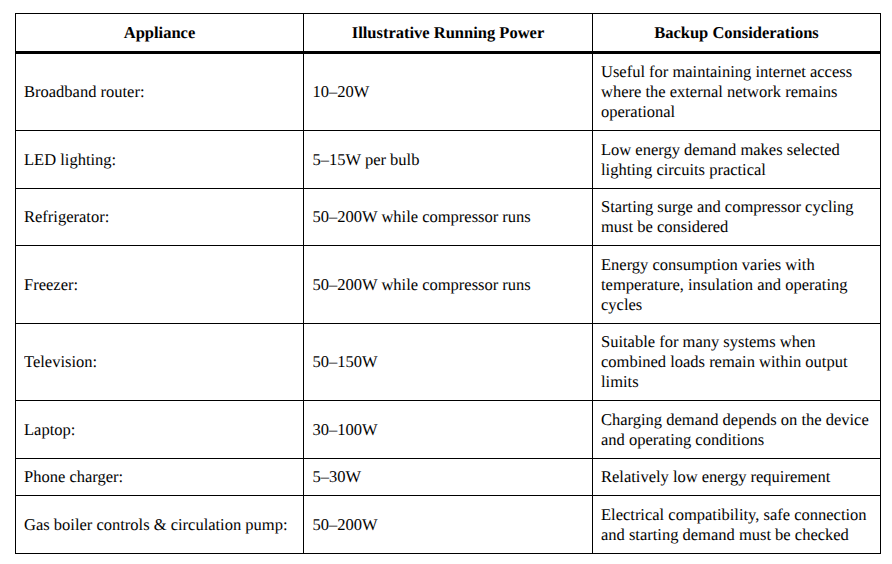
These figures are illustrative ranges rather than appliance-specific ratings. Always check the actual equipment before calculating your backup requirements.
High-powered electrical appliances can drain a home battery quickly or exceed the backup inverter's available output.
Examples include electric showers, immersion heaters, electric ovens, tumble dryers, high-powered kettles and EV chargers.
A 3kW kettle, for example, could consume approximately 0.25kWh during five minutes of operation. Although this may represent a relatively small amount of total stored energy, the inverter must still be capable of supplying the kettle's full instantaneous demand.
An electric shower requiring 8kW or more would exceed the output of many domestic battery inverters, regardless of how much energy remains in the battery.
The distinction between stored energy and available power is therefore essential when planning backup.
For many households, keeping essential appliances operating for several hours provides greater practical value than attempting to maintain normal electricity consumption throughout an outage.
Choosing a home battery for power cuts involves two separate calculations: how much power your appliances require at the same time and how much stored energy is needed to operate them for the desired duration.
Battery capacity is measured in kilowatt-hours (kWh), while inverter power output is measured in kilowatts (kW).
A battery with 10kWh of usable capacity could theoretically provide 1kW of electricity for ten hours. However, if its backup inverter is rated at 3kW, it cannot continuously supply a combined 5kW load simply because the battery contains enough stored energy.
Both specifications must be suitable for the intended appliances.
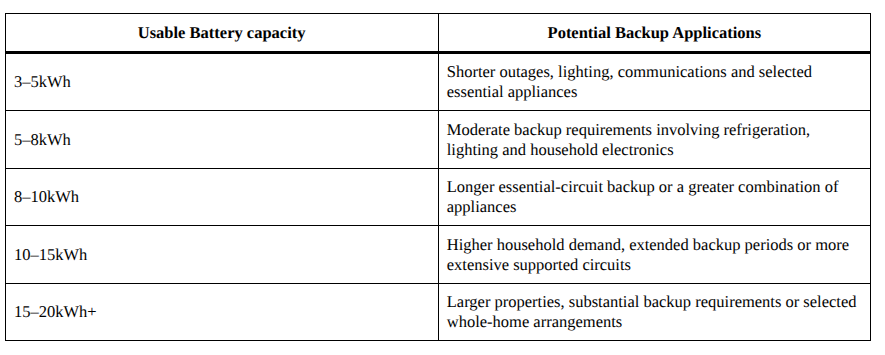
These ranges are general illustrations rather than fixed recommendations. The appropriate size depends on actual consumption, inverter output, available battery reserve and the length of outage you want to prepare for.
A smaller battery may provide useful emergency support if only essential equipment is connected. Conversely, a much larger battery can be depleted quickly when supplying high-powered appliances.
Start by listing the appliances you want to keep running during a power cut.
Check their running wattage and estimate how many hours each appliance will operate. Multiply the wattage by the expected operating time to estimate energy consumption in watt-hours.
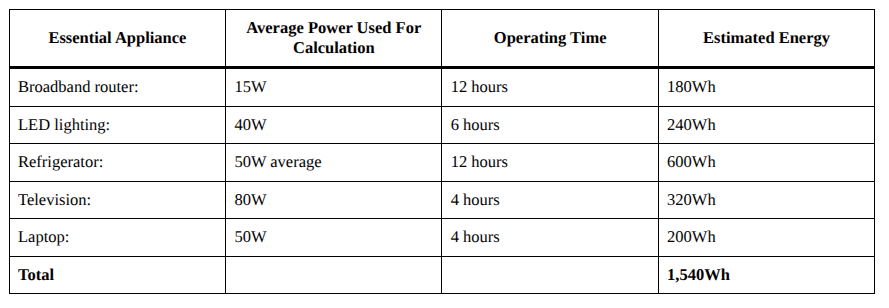
In this simplified example, the appliances require approximately 1.54kWh of electricity over the specified operating periods.
Allowing an illustrative additional 15% for conversion and system losses increases the estimated requirement to approximately 1.77kWh.
A battery with 3kWh of usable storage could therefore provide a reasonable energy margin for this particular scenario, assuming the inverter supports the connected appliances and sufficient battery charge is available when the outage begins.
However, this calculation does not account for every operating condition. Refrigerator compressor start-up, additional appliances, temperature changes and battery reserve settings can all affect the result.
For more dependable backup, calculate your requirements using realistic consumption and leave additional capacity for unexpected demand.
The length of time a home battery can supply electricity depends primarily on its usable stored energy and the average power consumed by the connected appliances.
A basic runtime calculation is:
For example, a battery containing 5kWh of usable energy could theoretically supply a constant 500W load for ten hours.
If the connected appliances consumed an average of 1kW, the same battery would last approximately five hours.
Actual runtime may be shorter because the inverter and other system components consume energy, battery operating limits restrict available discharge and household demand changes throughout the day.
The following table illustrates theoretical runtime using different usable battery capacities and average household loads.
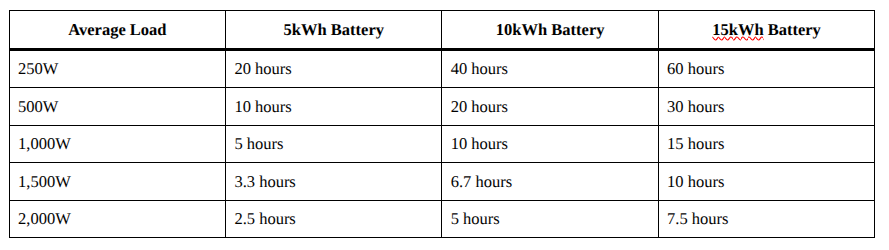
These calculations assume the stated battery capacity is available for use and exclude additional conversion losses, reserve settings and operating restrictions.
The difference between a 250W and 2,000W average load is substantial.
A household using its battery primarily for refrigeration, lighting and communications could potentially maintain essential services for considerably longer than one operating electric heating, cooking appliances and other high-demand equipment.
This is why planning which appliances will remain connected during an outage can be just as important as purchasing a larger battery.
Home battery backup systems can be designed to support an entire property or a smaller selection of essential electrical circuits.
The distinction affects installation complexity, equipment requirements, electricity consumption and how long the battery can remain operational during an outage.
Whole-home backup is designed to supply a property's electrical installation when grid power is unavailable, subject to the system's supported configuration.
This arrangement can provide greater convenience because more household circuits remain available without requiring occupants to move appliances or manually connect individual devices.
However, whole-home backup does not necessarily mean every appliance can operate simultaneously.
The inverter must still supply the combined electrical demand, and high-powered equipment may need to be restricted or managed to prevent overload.
A household with electric heating, an immersion heater, EV charging and multiple cooking appliances could require substantially more backup output than a property relying on gas heating and modest electrical loads.
Whole-home arrangements may also require additional switching equipment, higher-capacity inverters and more extensive installation work.
Essential-circuit backup supplies a designated selection of electrical circuits rather than the entire property.
These might include refrigeration, lighting, broadband equipment and selected sockets.
By limiting the number of connected appliances, homeowners can reduce the electrical demand placed on the battery and extend its available runtime.
For example, a household might choose to maintain its refrigerator, router and downstairs lighting while leaving electric cooking appliances, EV charging and non-essential sockets disconnected during an outage.
This approach can be more practical for households whose main priority is maintaining essential services until electricity is restored.
For many UK homes, essential-circuit backup offers a useful balance between installation cost, available battery capacity and emergency functionality.
The best arrangement depends on the property's electrical installation, the appliances you need to operate and how much disruption you want to avoid during a power cut.
Solar panels can recharge a home battery during a power cut, but only when the complete solar and battery system supports operation independently of the grid.
This is an important consideration for households purchasing battery storage primarily for emergency backup.
Under normal conditions, solar panels generate electricity that can be consumed by the home, stored in a battery or exported to the grid.
However, standard grid-connected solar inverters generally shut down when the mains supply fails.
A home battery with backup functionality does not automatically guarantee that its solar panels will continue generating usable electricity during an outage.
The inverter, battery, switching arrangement and solar equipment must support the relevant backup or islanded operating mode.
In a compatible system, the battery inverter can establish an independent electrical supply for supported household circuits after safely disconnecting from the public grid.
Solar generation may then continue operating within the system's permitted limits, supplying connected appliances and recharging the battery when surplus electricity is available.
This can extend backup duration, particularly during daylight hours when solar production exceeds household demand.
For example, a household with a partially discharged battery may use solar generation during the day to operate essential appliances while replenishing some of the stored energy for the evening.
However, the amount of electricity available depends on weather conditions, solar panel capacity, battery charge limits and the system's operating configuration.
During winter, solar production may be insufficient to fully recharge the battery, particularly if household electricity demand remains high.
Some systems may also require a minimum battery charge to start or maintain backup operation.
Before purchasing, confirm whether the proposed equipment supports solar charging during grid outages rather than assuming this is included with every solar battery installation.
Yes, a home battery can provide backup electricity without solar panels, provided it supports grid charging and emergency backup operation.
This arrangement allows homeowners to charge the battery from the mains electricity supply and retain stored energy for use when power is unavailable.
It can be particularly useful for properties where installing solar panels is impractical or where the main objective is maintaining essential household services during electricity interruptions.
Some compatible systems also allow scheduled charging using time-of-use electricity tariffs.
For example, a battery could charge overnight when electricity prices are lower, then provide stored energy during more expensive periods or retain a selected reserve for emergencies.
However, using a battery for both everyday tariff savings and emergency backup requires careful planning.
If the battery is routinely discharged to a very low charge level to maximise electricity savings, little stored energy may remain when an unexpected power cut occurs.
A suitable battery management system may allow homeowners to set a minimum reserve level, helping ensure electricity remains available for emergency use.
Without solar panels, the battery cannot replenish its energy from sunlight during an extended outage. Once its usable stored energy has been consumed, backup operation will normally end until another supported charging source becomes available.
For this reason, households prioritising emergency preparedness should consider both the desired backup duration and how the battery will be kept sufficiently charged.
Combining solar panels with home battery storage is one of the most common ways to make greater use of electricity generated at home.
Choosing a home battery specifically for emergency backup requires more than comparing storage capacity and purchase price.
The system must be able to operate safely when grid electricity is unavailable, supply the appliances you consider essential and retain enough energy for the expected outage duration.
The most important features to compare are:
A home battery intended to operate during power cuts requires appropriate electrical design, compatible equipment and professional installation.
Unlike a portable power station, a fixed home battery is integrated into the property's electrical infrastructure and may interact with solar generation, the consumer unit and the public electricity network.
Providing backup electricity introduces additional requirements because the supported circuits must operate safely when disconnected from the mains supply.
A qualified installer should assess the existing electrical installation, intended backup loads, inverter compatibility and suitable switching arrangements before recommending a system.
Homeowners should not attempt to create a backup supply by connecting an inverter or battery system directly to household wiring without suitable approved equipment and professional installation.
A correctly installed system should also be tested periodically in accordance with the manufacturer's instructions.
Understanding how the battery responds to a power cut before an emergency occurs can help avoid unexpected interruptions and identify whether any appliances need to be disconnected.
If you want to understand how to safely install your new battery storage system, our Complete Guide To Home Battery Storage is the best place to start. We'll take you through choosing the right location for your system and will even provide you with a quick and simple home battery installation checklist to make things as easy as possible.
Even a high-capacity home battery has a finite amount of stored energy. Reducing unnecessary electricity consumption can extend the time essential equipment remains operational.
The most effective approach is to prioritise appliances that provide the greatest practical benefit while avoiding high-powered equipment unless it is genuinely necessary.
For example, reducing average household demand from 1,000W to 500W could theoretically double the runtime available from the same amount of usable battery energy.
This makes careful energy management particularly valuable during prolonged outages or periods of limited solar generation.
Purchasing home battery storage for emergency use without checking the complete system can lead to unexpected limitations.
A battery may offer excellent storage capacity and everyday energy savings but still be unsuitable for keeping essential appliances running when grid electricity fails.
Avoiding these mistakes can help ensure your home battery delivers useful emergency backup rather than simply offering storage capacity that cannot be accessed when you need it.
Not necessarily. A home battery must have compatible backup functionality and appropriate switching equipment to supply electricity when the grid fails. Some systems switch automatically, while others require manual activation. Standard grid-connected batteries without backup capability may shut down during an outage.
A battery with 5kWh of usable energy could theoretically supply a constant 500W load for ten hours or a 1kW load for five hours. Actual runtime depends on inverter losses, available battery charge, reserve settings and household electricity consumption.
A 10kWh battery may support a whole-home backup arrangement if the inverter and electrical installation are appropriately designed. However, its ability to operate appliances depends on inverter output as well as stored energy. High-powered equipment can rapidly deplete the battery or exceed the system's available output.
Yes, but only when the complete solar and battery system supports operation independently of the grid. Standard grid-connected solar inverters normally shut down during a power cut. Compatible backup systems may allow solar electricity to continue supplying selected circuits and recharging the battery.
EPS provides emergency electricity when the mains supply fails, although a brief interruption may occur during changeover. UPS systems are designed to maintain supply continuity within specified requirements. A home battery advertising a fast transfer time should not automatically be assumed suitable for every sensitive electronic device.
Yes, provided the appliances are connected to the supported backup supply and their combined running and starting demands remain within the inverter's limits. Available runtime depends on battery capacity, compressor cycling and any other appliances using stored electricity.
Yes. Compatible home battery systems can charge from the electricity grid and provide backup during outages. However, without solar generation or another supported charging source, the battery cannot replenish its stored energy while the mains remains unavailable.
Not always. Whole-home backup provides greater flexibility but can require more expensive equipment and higher electrical output. Essential-circuit backup prioritises important appliances, often extending battery runtime and reducing installation complexity. The best arrangement depends on household requirements and budget.
Yes. The inverter must support the required backup or islanded operating mode and work with suitable grid isolation and switching equipment. A standard solar inverter or hybrid inverter does not necessarily provide emergency backup functionality.
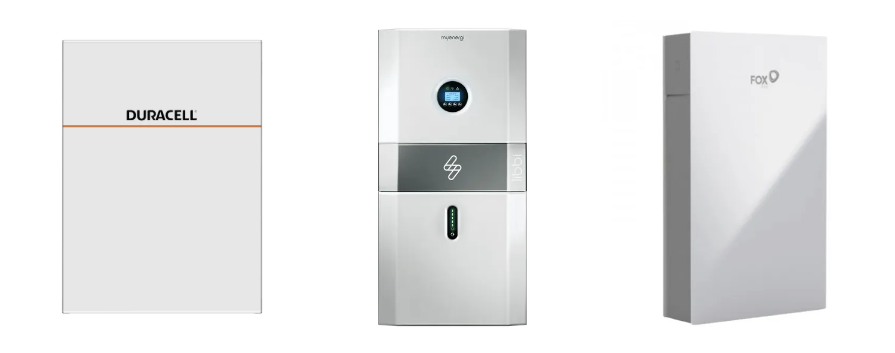
Home battery storage can provide valuable protection against electricity interruptions, but reliable backup depends on selecting a complete system that matches your household's requirements.
The most important starting point is deciding which appliances you need to keep running and how long you want them to operate. A household primarily concerned with refrigeration, internet access and lighting may require considerably less battery capacity than one seeking to maintain a larger proportion of its normal electricity consumption.
Next, check the system's backup functionality. Confirm that the inverter supports operation during grid outages, identify any additional switching equipment and establish whether essential-circuit or whole-home backup is appropriate.
Battery capacity and inverter output should then be considered together. The battery must contain enough usable energy for the desired runtime, while the inverter must supply the combined running and starting demands of connected appliances.
For homes with solar panels, the ability to continue generating and storing electricity during a power cut can provide additional resilience. However, this must be supported by the complete installation rather than assumed from the presence of solar panels alone.
Eco Wizard offers a range of home battery storage solutions, compatible inverters and home power equipment for households looking to manage electricity consumption and explore backup power options. Whether you're adding battery storage to an existing solar installation or planning a new system, understanding the equipment's capabilities will help you make a more informed purchasing decision.
For our most detailed look at choosing the right battery capacity and inverter, adding storage with or without solar panels, and weighing up installation costs and potential savings, see our Complete Guide To Home Battery Storage.