
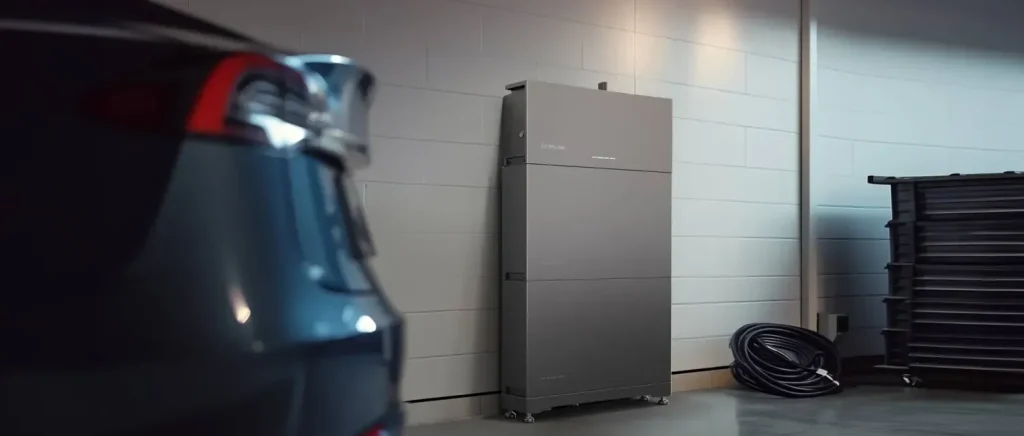
Described as an "increasingly popular way to reduce your bills by creating a smarter, more flexible energy system at home”, home battery storage is changing how households generate, store and use electricity. Rather than relying entirely on the grid, homeowners can store surplus energy from solar panels, charge batteries when electricity prices are lower and make use of that stored power when they need it most. For households looking to bring down energy bills, make better use of renewable electricity or prepare for power cuts, home battery storage offers an increasingly practical solution.
The technology has developed considerably in recent years. Modern home battery systems combine long-life lithium batteries with intelligent inverters, energy monitoring and smart charging controls. Many can work alongside existing solar installations, while others operate independently using electricity imported from the grid. Selected systems also offer expandable storage, automated tariff-based charging and emergency backup functionality.
However, choosing the right home battery is not as straightforward as comparing storage capacities...
A 5kWh battery does not necessarily provide 5kW of power. A system designed to reduce electricity bills may not supply electricity during a power cut, and a battery that works with one solar inverter may be incompatible with another. Installation costs, usable capacity, charging efficiency and household electricity consumption can all influence whether a particular system represents good value.
There is also the question of whether battery storage is worth the investment. While storing cheaper or self-generated electricity can reduce the amount purchased from the grid, the financial benefits depend on your electricity tariff, solar generation, installation costs and daily energy usage. Choosing a battery that is too small may limit your savings, while an unnecessarily large system could take considerably longer to recover its initial cost.
In this complete guide, Eco Wizard will give you all the help you need and explain everything you must know about home battery storage in the UK. From battery capacity, inverter technology and installation costs to solar compatibility, emergency backup and long-term savings, we'll delve into the details of battery technology and choosing a system that suits your home, energy requirements and budget.
Home battery storage is a rechargeable energy storage system that allows households to save electricity to use at a later time. Instead of immediately consuming or exporting all the electricity generated by solar panels, a compatible battery system can store up that surplus energy and make it available when household demand increases or solar generation falls.
Think of it as a brilliant energy reserve for your home. Electricity enters the battery from a compatible solar installation or the grid, is stored as chemical energy and is released when you need it. An inverter converts the battery's stored electricity into a form that standard household appliances can use.
A typical home battery installation includes battery modules, a battery management system (BMS), an inverter or power conversion system and equipment that monitors electricity flowing between the property, battery and grid. Many systems also include appealing smart features such as internet connectivity and an app, allowing homeowners to monitor charging, electricity consumption and available storage.
For homes with solar panels, the process usually begins during daylight hours. Solar electricity is used to meet household demand, with surplus generation directed into the battery where the system supports this arrangement. Once the battery reaches its charging limit, additional electricity may be exported to the grid or managed through other compatible equipment.
When solar generation decreases, the battery can discharge to support household electricity demand. This allows energy generated earlier in the day to power appliances during the evening, when electricity consumption is often higher.
What's more, home batteries can also operate without solar panels. With a suitable electricity tariff and compatible charging controls, homeowners can charge their battery during lower-cost periods and use the stored energy when grid electricity becomes more expensive.
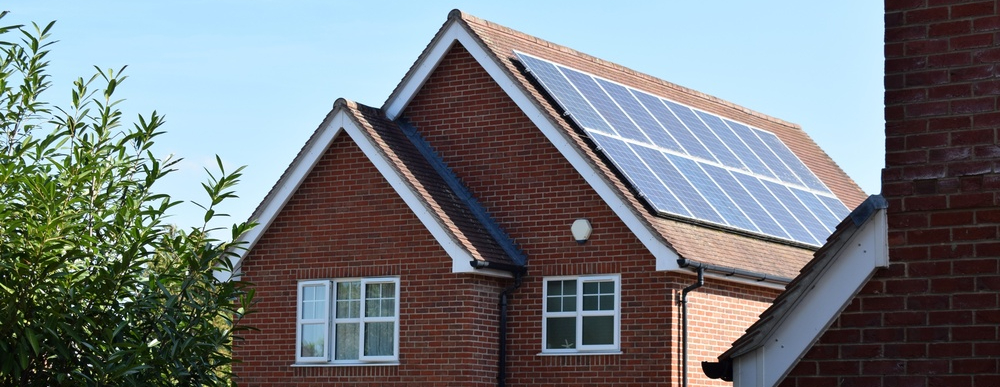
Home battery storage offers homeowners greater control over how electricity is stored, managed and consumed, helping households make more efficient use of their available energy. Rather than relying entirely on electricity from the grid, a home battery allows you to store surplus electricity generated by solar panels or charge using cheaper off-peak tariffs, making that energy available when household demand increases or electricity prices are higher.
Beyond potential savings on electricity bills, home battery storage can improve energy self-sufficiency, reduce dependence on grid electricity and provide greater flexibility in managing everyday household consumption. Certain systems can also supply essential appliances during power cuts, provided suitable backup functionality is installed. These benefits make battery storage a practical option for households looking to manage energy costs, maximise their solar investment or improve their resilience against electricity supply interruptions.
One of the most important distinctions when choosing home battery storage is the difference between capacity and power output. These measurements are closely related, but they describe two different aspects of battery performance.
Battery capacity determines how much electricity can be stored. Power output determines how much electricity the system can deliver at any one time.
For example, a battery with 10kWh of usable storage capacity could theoretically supply a constant 1kW load for ten hours, or a 5kW load for two hours. Actual runtime will be affected by conversion losses, operating conditions and the system's permitted discharge limits.
However, a 10kWh battery cannot necessarily supply 10kW of power. If its inverter provides a maximum continuous output of 3kW, the combined demand of appliances supplied through that inverter must remain within the applicable output limit.
This distinction becomes particularly important when considering high-powered household appliances. Electric ovens, kettles, immersion heaters, heat pumps and EV chargers can place substantial demands on a home electrical system.
A battery may have enough stored energy to operate these appliances for a period, but its inverter must also be capable of delivering the required power.
Another important specification is usable capacity. Some manufacturers advertise the total nominal capacity of their batteries, while others quote the amount available for normal use. These figures may differ because the battery management system reserves part of the stored energy to protect the cells and maintain their operating limits.
Efficiency also matters. Charging and discharging a battery involves energy losses, meaning not every kilowatt-hour used to charge the system will eventually reach household appliances.
Choosing the correct home battery size starts with understanding how much electricity your household uses, when that electricity is consumed and how frequently the battery can be recharged.
A household using 10kWh of electricity each day does not automatically need a 10kWh battery. If much of that electricity is consumed while solar panels are generating, a smaller battery may be sufficient to store surplus energy for evening use.
Equally, a household with high evening consumption may benefit from greater storage capacity, particularly if it has enough solar generation or access to lower-cost electricity to recharge the battery regularly.
Start by checking your electricity bills or smart meter data to establish your average daily consumption. Annual electricity usage can be divided by 365 to provide a starting estimate, although this will not show how demand changes throughout the day.
For more accurate sizing, look at when your household uses electricity. Evening consumption, overnight demand and the amount of surplus solar generation available are particularly useful figures.
For example, consider a household that uses approximately 12kWh of electricity per day. If 5kWh is consumed directly while solar panels are generating, the remaining 7kWh may need to come from stored energy or the grid.
A battery with approximately 7kWh of usable capacity could potentially cover much of that remaining demand, provided sufficient energy is available to charge it and the inverter can meet the required power output.
However, the calculation changes during winter, when solar generation is generally lower and household electricity demand may increase.
The following capacity ranges provide a general starting point for comparing domestic battery systems.
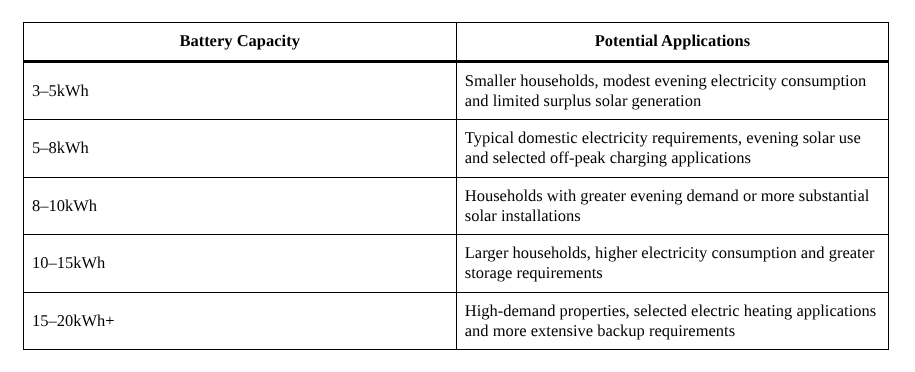
These are illustrative categories rather than fixed recommendations. The appropriate capacity depends on usable storage, electricity consumption, charging opportunities and system output.
A larger battery is not always more economical. If a household regularly generates only 3kWh of surplus solar electricity, installing a 15kWh battery solely for solar storage may leave much of its capacity unused.
On the other hand, households planning to install a heat pump or purchase an electric vehicle may want to consider how their electricity requirements could change.
The most suitable battery is one that can be charged and used effectively, rather than simply the largest system available.
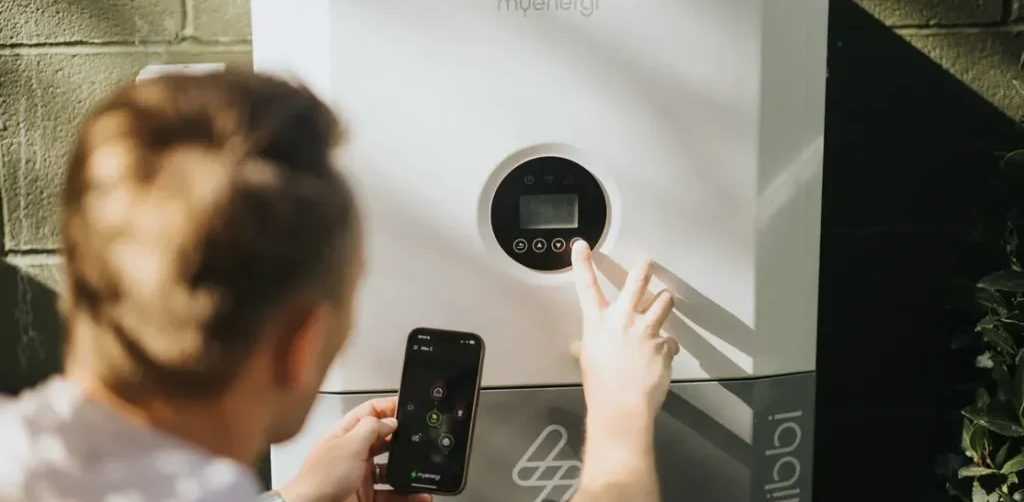
An inverter is one of the most important components in a home battery storage installation. Although batteries receive much of the attention, the inverter determines how stored electricity is converted, delivered and managed within the property.
Home batteries store electricity as direct current (DC). Most standard UK household appliances operate using alternating current (AC), supplied through the property's electrical installation. The inverter converts DC electricity into usable AC electricity, allowing energy stored in the battery to power compatible household appliances. In systems connected to the grid, the inverter must also coordinate with the electrical supply. It manages power conversion and operates alongside protection and monitoring equipment to ensure electricity is supplied within the system's permitted limits.
Different inverter designs offer different capabilities. Some are intended primarily for solar generation, while others support battery charging, discharging and more advanced energy management.
A conventional solar inverter converts DC electricity generated by solar panels into AC electricity for household use or grid export. A hybrid inverter combines solar conversion with compatible battery storage functionality. Depending on the model, it can manage electricity generated by solar panels, charge a connected battery and discharge stored energy to support household demand.
This makes hybrid inverters particularly useful when installing solar panels and battery storage together.
However, hybrid does not automatically mean backup-capable. Some hybrid inverters shut down during a power cut unless they are equipped with the appropriate backup functionality and correctly installed switching equipment.
A dedicated battery inverter allows a compatible storage system to charge and discharge through the property's AC electrical installation. These systems are commonly used when adding battery storage to a home that already has solar panels and a functioning solar inverter.
Instead of replacing the existing solar inverter, the battery system can operate through a separate conversion arrangement. The choice between inverter types depends on the existing electrical installation, battery compatibility and intended use.
Most UK homes have a single-phase electricity supply, although some larger properties and commercial buildings use three-phase connections. Single-phase battery inverters are designed for compatible single-phase installations. Three-phase systems can distribute power across multiple phases, subject to the equipment and installation configuration.
It is important to match the inverter to the property's electrical supply and the battery system's requirements.
Choosing a suitable inverter is just as important as choosing the battery itself. An incompatible or undersized inverter can limit the performance of an otherwise capable storage system.
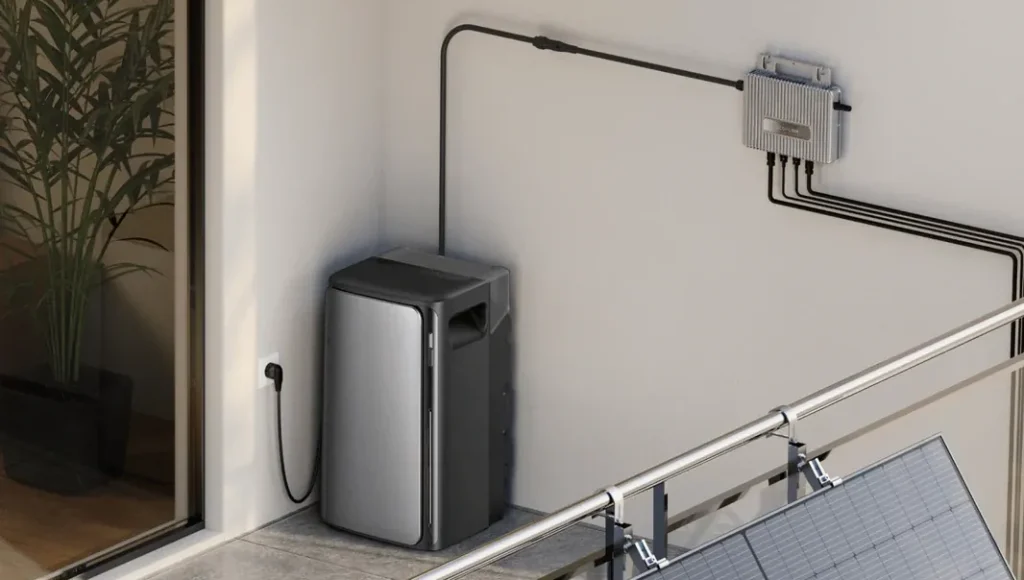
Home battery storage systems are commonly described as AC-coupled or DC-coupled. These terms refer to how the battery connects to the wider electrical system and how electricity moves between solar panels, storage and household appliances.
Both arrangements can provide effective home energy storage, but their design, installation requirements and conversion processes differ.
An AC-coupled battery system connects to the AC side of the property's electrical installation through suitable battery conversion equipment. This arrangement is particularly useful for homes that already have solar panels and a conventional solar inverter.
The existing solar inverter converts electricity from the panels into AC. Surplus electricity can then be used to charge the battery through the battery system's own power conversion equipment.
When stored electricity is needed, the battery inverter converts it back into AC for household use. AC coupling can therefore make it possible to add battery storage without replacing an existing, compatible solar installation.
However, charging a battery from solar-generated AC electricity involves additional conversion stages, which can introduce energy losses.
A DC-coupled system connects the battery to a compatible DC-side power conversion arrangement, commonly using a hybrid inverter. Solar electricity can be directed into the battery before being converted into AC for household use. This can reduce the number of conversion stages when storing surplus solar electricity, potentially improving efficiency under suitable operating conditions.
DC coupling is often attractive when installing solar panels and battery storage together, as the system can be designed around compatible components from the beginning.
However, the battery must be compatible with the inverter, and adding storage to an existing solar installation may require additional equipment or replacement of the original inverter.
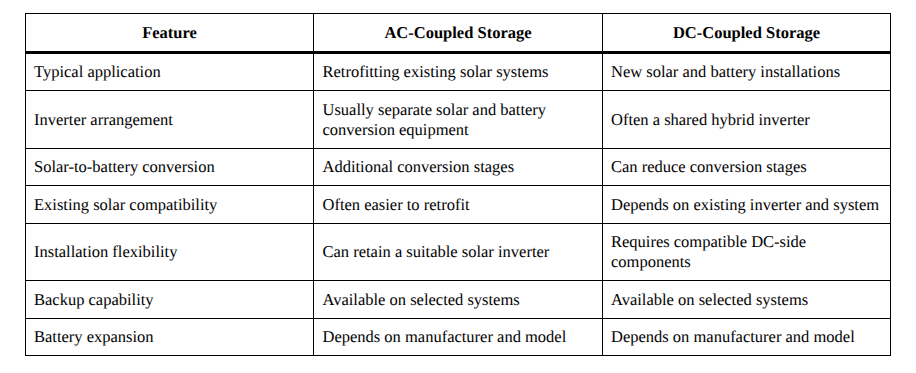
Neither architecture is automatically better for every property.
For homeowners with an existing solar installation, AC coupling may offer a convenient route into battery storage. For a new solar and battery installation, DC coupling may provide an efficient and integrated solution. The best choice depends on the equipment already installed, the system's intended operation and the cost of achieving the required functionality.

Combining solar panels with home battery storage is one of the most common ways to make greater use of electricity generated at home.
Solar panels produce electricity during daylight hours, but household demand does not always coincide with generation. A battery helps bridge this gap by storing surplus electricity until it is needed. For example, a solar installation may generate more electricity than a household consumes during the middle of the day. Without battery storage, the surplus can be exported to the grid.
With a compatible battery, some of that electricity can be retained for use during the evening, reducing the amount purchased from the electricity supplier. This can be particularly useful for households where occupants are away during the day and return home when solar generation is decreasing.
However, solar battery performance depends heavily on the amount of surplus electricity available.
During summer, a suitable solar installation may regularly generate enough electricity to meet daytime demand and recharge the battery. During winter, shorter days and lower solar generation can make full charging less frequent.
A home battery does not increase the amount of electricity generated by solar panels. Instead, it changes when that electricity can be used.
When your home battery reaches its maximum permitted charge level, surplus electricity generated by your solar panels doesn't have to go to waste.
Depending on your installation, excess energy can be exported to the National Grid, redirected towards compatible equipment such as an electric vehicle charger or immersion heater, or limited by the system's energy management controls. This allows your solar installation to continue delivering value even when your battery is fully charged.
Through the government's Smart Export Guarantee (SEG), eligible homeowners can earn money for surplus renewable electricity exported to the grid. Participating electricity suppliers pay for each eligible kilowatt-hour (kWh) exported, creating an additional financial benefit from your solar installation. Export rates vary between suppliers and tariffs, with some offering higher payments during particular periods. Eligibility depends on factors including your generation equipment, export metering and the supplier's requirements.
For homeowners with battery storage, this creates an opportunity to maximise the value of their solar electricity. Storing surplus energy can reduce grid electricity costs, while exporting it can generate additional income. The most cost-effective approach depends on electricity tariffs, battery efficiency and household consumption.
Home battery storage can be a worthwhile investment for UK households looking to reduce electricity bills, make better use of renewable energy and gain greater control over when they purchase electricity from the grid.
With smart electricity tariffs and increasingly sophisticated battery management technology, homeowners have more opportunities to store electricity when it's cheaper or readily available and use it when it offers the greatest financial benefit.
For households with solar panels, a battery helps maximise solar self-consumption, storing surplus electricity generated during daylight hours for use in the evening or overnight. This can reduce reliance on grid electricity and improve the overall value of a solar installation. However, homeowners should also consider potential Smart Export Guarantee (SEG) earnings, as exporting surplus electricity may sometimes be more financially beneficial than storing it.
Even without solar panels, battery storage can offer savings through time-of-use electricity tariffs. By charging during cheaper off-peak periods and using stored electricity when prices increase, households can reduce their exposure to higher electricity rates. Some compatible smart battery systems can automate charging schedules, making it easier to take advantage of these price differences.
Ultimately, whether home battery storage is worth the investment depends on the system's installed cost, usable capacity, efficiency, electricity tariffs and how frequently the battery is used. The greatest financial benefits generally come from regularly shifting meaningful amounts of electricity away from expensive grid consumption, although savings and payback periods will vary between households.
The potential savings from home battery storage depend largely on the difference between the cost of charging the battery and the value of the electricity it supplies. For households using time-of-use tariffs, this can create opportunities to purchase electricity at lower rates and avoid more expensive grid consumption later.
Consider a simplified example of a 10kWh battery charged using cheaper overnight electricity, assuming round-trip efficiency of 90%:
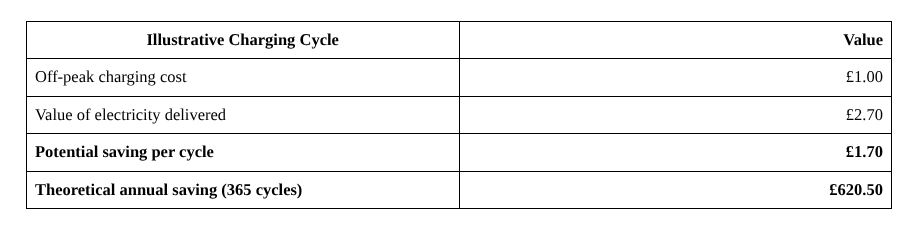
Illustrative electricity rates only. Assumes a full equivalent charging cycle every day and excludes battery purchase, installation, degradation, maintenance and other operating costs.
Under these conditions, the battery could theoretically deliver approximately £620 in annual electricity savings. However, actual savings are likely to vary because household demand, electricity tariffs, battery efficiency and charging opportunities change throughout the year. A battery may not complete a full equivalent cycle every day, and the initial installation cost must also be considered when assessing long-term financial returns.
For solar-powered battery systems, the calculation is slightly different. Storing surplus solar electricity reduces future grid purchases, but it may also mean sacrificing income available through the Smart Export Guarantee. The greatest financial benefit therefore comes from balancing avoided electricity costs, potential export earnings and battery efficiency, rather than simply storing as much electricity as possible.
The payback period is the time required for cumulative financial savings to recover the initial investment.
A basic calculation is:
For example, a system costing £5,000 and delivering annual savings of £500 would have a simple payback period of ten years.
This is a simplified estimate rather than a guaranteed outcome. It excludes financing costs, future electricity price changes, equipment replacement and changes in battery performance.
For some households, battery storage can offer meaningful financial benefits. For others, the installation cost may outweigh the savings available. The strongest investment decisions are based on realistic calculations using actual electricity consumption, tariff information and installation quotations.
The cost of home battery storage in the UK varies considerably depending on battery capacity, inverter requirements, manufacturer, installation complexity and whether the system is being installed alongside solar panels.
According to the Energy Saving Trust's 2026 guidance, battery storage systems can cost approximately £1,500 to £10,000, with a 5kWh system costing around £4,600. These figures provide a useful general benchmark, although actual quotations will vary according to the equipment and installation.
A small battery installation may be suitable for modest electricity requirements, while larger modular systems can involve substantially higher equipment and installation costs.
It is also important to distinguish between the advertised price of a battery module and the cost of a complete, operational installation. Some battery products require a separately purchased inverter, battery management equipment, mounting accessories or additional electrical components.
Installation costs can also increase where existing electrical equipment requires modification or where additional backup circuits and switching arrangements are requested.
A complete home battery installation may involve several separate components.
Installing battery storage at the same time as solar panels can sometimes reduce the overall installation cost because some electrical work and equipment can be planned together.
Retrofitting a battery to an existing solar installation may also be straightforward, particularly where the existing equipment supports the proposed storage arrangement. However, replacing an incompatible inverter or adding extensive backup functionality can increase the cost.

One of the most appealing reasons to consider home battery storage is the possibility of keeping essential electrical equipment running during a power cut. However, an important distinction must be made: not every home battery system can provide backup electricity when the grid fails.
Many standard grid-connected battery systems are designed primarily to reduce electricity purchases and manage solar energy. During a power cut, they may automatically disconnect and stop supplying household circuits. This behaviour is an important safety requirement. Grid-connected equipment must not continue energising the public electricity network when the mains supply is unavailable.
To provide backup electricity, a battery installation needs suitable equipment that can safely isolate the supported electrical circuits from the grid and supply them independently. Depending on the system, this may involve a backup-capable inverter, an emergency power supply (EPS) output, an automatic changeover arrangement or a dedicated backup distribution board.
Emergency Power Supply (EPS) functionality allows compatible battery systems to provide electricity during a grid outage. Some systems require manual intervention, while others can automatically switch to backup operation when the mains fails.
However, the changeover may involve a brief interruption to the electrical supply.
An Uninterruptible Power Supply (UPS) works to maintain power to connected equipment within a specified transfer or continuity requirement. The distinction matters for sensitive equipment such as desktop computers, servers and communication systems.
A battery inverter advertising backup capability should not automatically be treated as a true UPS. Check the manufacturer's stated transfer time and whether the connected equipment can tolerate any interruption.
The answer depends on battery capacity, inverter output and how the backup system has been installed...
A suitably configured battery may support lighting, refrigeration, internet equipment, televisions, laptops and other essential appliances. Higher-powered equipment, including electric showers, immersion heaters, ovens and EV chargers, may exceed the backup inverter's output or consume stored energy very quickly.
Many households therefore benefit from prioritising essential circuits rather than attempting to supply every appliance.
A properly designed backup system can provide valuable reassurance, but its capabilities must be established before installation.
Yes, a home battery can supply electricity to a house, but whether it can power the entire property depends on its capacity, inverter output and electrical configuration.
During normal grid-connected operation, a home battery can contribute electricity towards household demand while the grid supplies any additional power required. For example, if a household is consuming 4kW and its battery system can deliver 3kW, the remaining 1kW may be imported from the grid, assuming no other generation is available.
This allows a battery to reduce electricity purchases without necessarily supporting the entire household load.
During a power cut, the situation is different. The system must operate independently of the grid, and only circuits connected through the approved backup arrangement can receive electricity. A battery with sufficient capacity may still be unable to operate high-powered appliances if the backup inverter cannot supply their combined demand.
Battery runtime depends on the amount of usable stored energy and the average electrical load.
A basic estimate can be calculated using:
For example, a battery with 10kWh of usable energy supplying a constant 1kW load would theoretically last ten hours before allowing for additional losses and operating restrictions. If the same battery supplied a constant 2kW load, the theoretical runtime would fall to five hours.
The following table illustrates how average demand affects runtime.
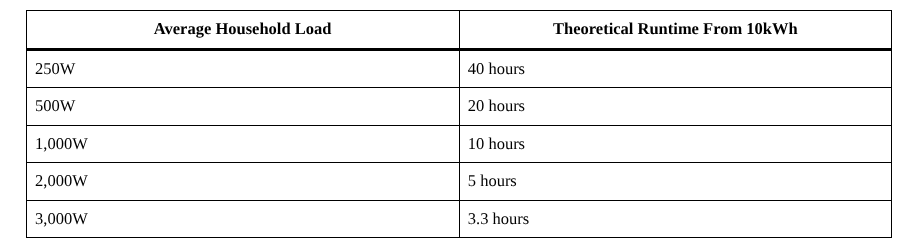
These examples assume 10kWh is available for use and exclude additional conversion losses. They are not guaranteed operating times.
Actual household consumption changes continuously as appliances switch on and off. A refrigerator may operate intermittently, while an electric kettle draws substantial power for a short period. Heating systems, cooking equipment and EV charging can also create large variations in demand.
For this reason, a household with a 10kWh battery may achieve substantially longer backup runtime by limiting consumption to essential appliances.
Modern home battery systems offer more than basic electricity storage. Many include intelligent controls that allow charging and discharging to be scheduled around electricity tariffs, solar generation and household demand. This can be particularly useful for UK households using time-of-use electricity tariffs, where the price of electricity varies depending on when it is purchased.
A compatible battery can charge during cheaper periods and discharge when prices increase, reducing the amount of electricity purchased at higher rates.
Some systems allow homeowners to create fixed charging schedules through an app. Others offer more advanced automation, adjusting battery operation according to electricity prices, predicted solar generation or household consumption. The level of automation varies between manufacturers and models.
A typical smart charging arrangement begins with an electricity tariff offering different rates throughout the day. The homeowner or energy management system identifies lower-cost charging periods and instructs the battery to charge during those windows.
When electricity prices increase, the battery can discharge to support household demand.
For homes with solar panels, smart controls may also prioritise solar charging or reserve capacity for expected generation later in the day. For example, a battery could charge from the grid overnight during winter, when solar generation is limited, but rely more heavily on surplus solar electricity during summer.
However, intelligent charging does not guarantee the lowest possible electricity cost. Its effectiveness depends on tariff compatibility, forecasting accuracy, system settings and the household's actual demand.
Before choosing a battery for smart tariff use, confirm that its control system supports the required charging schedules and electricity tariff arrangements.
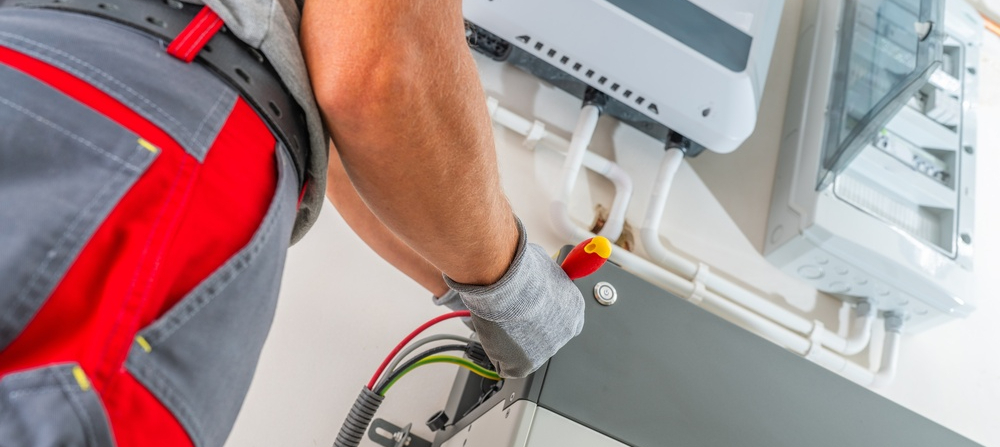
Home battery storage is a permanent electrical installation that requires appropriate system design, electrical protection and professional installation. Unlike a portable power station, a domestic battery system is typically connected to the property's electrical infrastructure, often operating alongside solar panels, an inverter and the electricity grid.
Professional installation is essential for ensuring electrical safety, reliable performance and compliance with UK requirements.
Before recommending a system, a suitably qualified installer should assess the property's electrical supply, consumer unit, earthing arrangements, existing solar inverter and available installation space. They should also establish whether the battery will provide everyday energy storage, emergency backup power or both, as these requirements can influence equipment selection, electrical protection and installation costs.
Choosing the right location for a home battery is important for safety, performance and long-term reliability. Depending on the manufacturer's specifications, batteries may be suitable for installation in garages, utility rooms, outbuildings or designated outdoor areas. However, not every battery is approved for every environment, even if its enclosure offers protection against dust and water.
Installers must consider operating temperatures, ventilation, moisture exposure, accessibility and the manufacturer's required clearances. Lithium-ion batteries can generate heat during operation, while exposure to excessive temperatures may reduce charging performance or accelerate battery degradation. Outdoor installations must also account for environmental exposure and the manufacturer's permitted installation conditions.
Fire safety is another important consideration. The IET Code of Practice for Electrical Energy Storage Systems and the MCS Battery Storage Installation Standard (MIS 3012) provide guidance on safe system design and installation. Particular attention should be given to escape routes, fire separation, suitable mounting surfaces and access for emergency services.
A battery should never be positioned solely for convenience without assessing its suitability and safety requirements.
The Distribution Network Operator (DNO) manages the local electricity distribution network and oversees the connection of home battery storage systems capable of exporting electricity to the grid.
Grid-connected battery installations must follow the applicable UK engineering requirements. G98 generally covers qualifying small-scale installations up to 16A per phase (approximately 3.68kW on a single-phase supply), while G99 applies to larger installations or those that do not meet G98 requirements. Depending on the configuration, installers may need to notify the DNO after installation or obtain approval beforehand.
Where electricity exports need to be restricted, G100 provides requirements for export limitation schemes alongside the applicable G98 or G99 connection process. Importantly, the assessment may consider the combined output of existing solar panels and battery inverters, rather than the battery system alone.
A suitably qualified installer should establish the correct connection procedure, arrange any necessary DNO approval and complete the required documentation. MCS battery installation standards also cover system design, electrical safety and compliance with relevant grid connection requirements.
Correct installation is essential for safe, reliable operation and long-term battery performance.
Choosing home battery storage starts with understanding what you want the system to achieve. Some homeowners want to make greater use of their solar electricity, while others are primarily interested in cheaper overnight charging, emergency backup or reducing their reliance on the grid.
The best home battery is one that matches those requirements without adding unnecessary capacity, complexity or expense.
Start by examining your electricity consumption and how it changes throughout the day. A household with substantial evening demand may benefit from a larger battery, while a property with limited surplus solar generation could achieve better value from a smaller system.
Next, consider how the battery will be charged. If you already have solar panels, compatibility with the existing inverter is an important starting point. If you are installing solar panels and battery storage together, a compatible hybrid inverter may provide a more integrated solution.
For households planning to charge from the grid, smart tariff compatibility and charging schedules become particularly important.
Power output should also influence your decision. A battery with sufficient capacity may still be unsuitable if its inverter cannot support the appliances you intend to run simultaneously.
Look beyond the battery's advertised storage capacity and compare the complete system. Usable energy, inverter efficiency, warranty coverage, installation requirements and expansion options can all affect long-term value.
Eco Wizard offers a selection of home energy storage equipment, including compatible battery modules, inverters and solar power solutions. Comparing these components as part of a complete system can help you identify equipment that suits your existing installation and future energy requirements.
A well-matched battery system should deliver useful storage capacity, suitable power output and the functionality you actually need, without requiring you to pay for features or capacity that provide little practical benefit.
At Eco Wizard, we offer an extensive range of home battery storage systems to suit different household energy requirements and budgets. Individual battery modules start from around £750 and larger, expandable battery systems exceed £10,000. Our range includes leading manufacturers such as Fox ESS, SolaX, Pylontech, Dyness, EcoFlow and Duracell, with 5kWh battery modules available from around £800-£1,500, and selected 10kWh battery systems starting from approximately £1,600.
Prices depend on battery capacity, manufacturer and system configuration, with compatible inverters, backup equipment and professional installation potentially adding to the overall cost.
The ideal battery size depends on how much electricity your household uses, particularly during evenings and overnight, and how much surplus solar energy is available to store. A 3-5kWh battery may suit smaller households with modest energy requirements, while larger families or higher-consumption properties may benefit from 10kWh or more. Checking your smart meter data is a useful starting point for avoiding an oversized or undersized system.
A 10kWh battery with 10kWh of usable capacity could theoretically supply a constant 1kW load for ten hours or a 2kW load for five hours, before accounting for energy losses. Actual runtime depends on the appliances you're powering, inverter efficiency and battery operating limits. Running essential appliances instead of high-demand equipment can considerably extend battery life between charges.
Yes. Home battery storage doesn't require solar panels to be useful. Compatible systems can charge using cheaper off-peak grid electricity, storing it for use when electricity prices rise. This can help reduce energy bills even without solar generation, although potential savings depend on tariff differences, system efficiency and installation costs.
Yes, provided the battery capacity, inverter output and electrical installation can meet your household's requirements. While a suitable system can power everyday appliances, high-demand equipment such as electric showers and EV chargers may exceed its output limits. Whole-home operation during a power cut also requires compatible backup equipment and appropriate grid isolation.
Not automatically. Many grid-connected battery systems shut down during power cuts, even when they contain stored electricity. To keep your home powered, the installation needs compatible backup functionality, appropriate switching equipment and safe grid isolation. Depending on the system, backup electricity may be available to selected essential circuits or the entire property.
AC-coupled batteries use a separate battery inverter, making them a practical option for adding storage to existing solar installations. DC-coupled batteries typically connect through compatible hybrid inverters, allowing solar electricity to charge the battery with fewer conversion stages. DC coupling can improve charging efficiency, while AC coupling often offers greater flexibility when retrofitting an existing system.
Modern home battery storage systems have an expected lifespan of around 10-15 years, although high-quality lithium iron phosphate (LiFePO₄) batteries may remain operational for 15-20 years, or longer, under optimal operating conditions. Many LiFePO₄ batteries are rated for 6,000 or more charging cycles, with a proportion of their original storage capacity remaining afterwards.
Actual lifespan depends on battery chemistry, operating temperature, charging habits and usage. Battery warranties commonly extend to 10 years, although this does not necessarily represent the system's maximum working life.
Yes, battery storage can often be added to an existing solar panel installation. An AC-coupled battery system may allow you to retain your current solar inverter, while a DC-coupled arrangement may require a compatible hybrid inverter. The most suitable option depends on your existing equipment, electrical configuration and intended storage capacity.
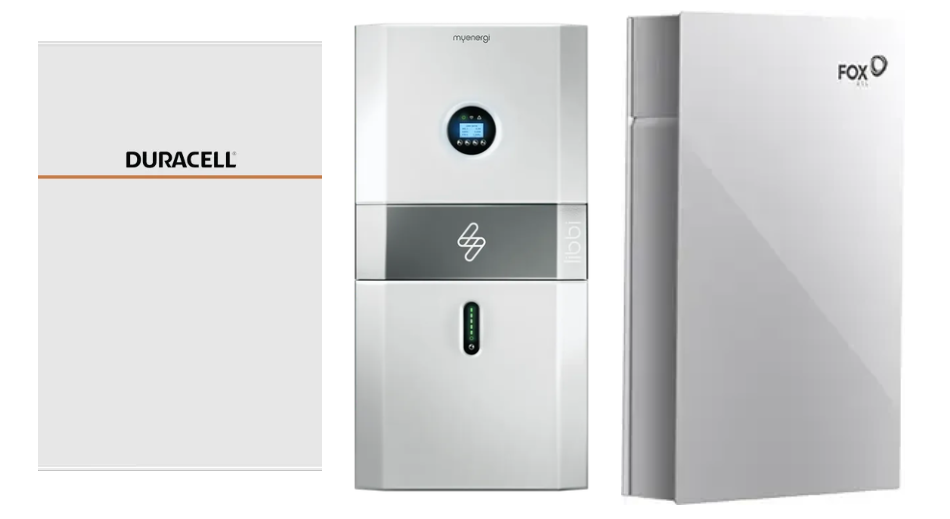
At Eco Wizard, we offer a range of home battery storage solutions, solar inverters and compatible energy storage equipment designed to help UK households make more effective use of electricity. Whether you're adding storage to an existing solar installation, planning a complete solar and battery system or exploring ways to benefit from lower-cost electricity tariffs, our range provides options for different household requirements.
From modular battery systems with expandable storage capacity to hybrid inverters and intelligent energy management technology, you can explore equipment designed to make storing, monitoring and using electricity more convenient.
Choosing the right system starts with understanding your energy consumption, installation requirements and long-term priorities. With the right combination of battery capacity, inverter technology and charging controls, home battery storage can become a valuable part of a more flexible and efficient household energy system.


