
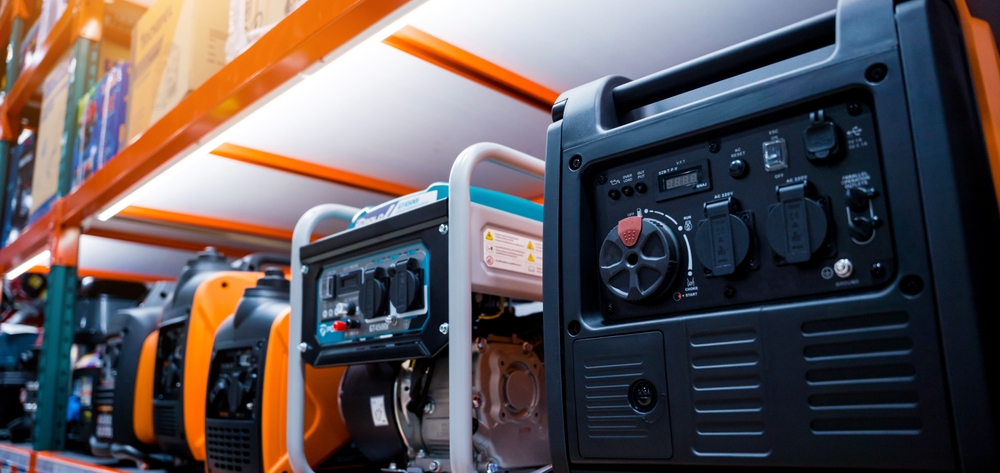
Portable power stations and generators both provide electricity when mains power is unavailable, but they produce it in fundamentally different ways. A portable power station stores electricity in a rechargeable battery and delivers it through AC, USB and DC outputs. A conventional generator burns petrol, diesel, LPG or another fuel to produce electricity while its engine is running.
For most households, campers and occasional users, a portable power station is usually the more convenient option. It is quiet, requires little routine maintenance, produces no exhaust fumes at the point of use and can power compatible equipment indoors when used according to the manufacturer's instructions. It can also be recharged from mains electricity, a vehicle or compatible portable solar panels.
A fuel generator still has crucial advantages. It can provide high continuous output and continue operating for as long as a safe fuel supply and maintenance allow. This makes it valuable for long power cuts, remote worksites and applications where large loads must run for extended periods. Refuelling a fuel generator can also be faster than recharging a depleted battery.
However, generators do bring significant compromises...
Their engines produce noise and exhaust emissions - including pollutants that contribute to local air pollution. Fuel must be stored safely, routine maintenance is often required, and the unit must never be operated indoors or in a partially enclosed area. Carbon monoxide is colourless and odourless, and fumes can be fatal even when doors or windows are fully open.
The better option for you depends on the load, required runtime, operating environment and access to fuel or recharging points.
A compact portable power unit may be ideal for smartphones, laptops, routers and lighting, while a high-capacity expandable power station can be used to run refrigerators and many household appliances. A generator may be more suitable for continuous heavy-duty equipment or a prolonged outage with no reliable opportunity to recharge.
In this guide, Eco Wizard compares portable power stations and generators across the factors that matter most. We explain the differences in output, runtime, noise, safety, cost, maintenance and environmental impact before identifying which option is better for power cuts, camping, motorhomes, tools and off-grid use.
If you want to make a more informed decision before buying a portable power station, delving deeper into definitions and terminology, the features that really matter and much more, see our Complete Guide To Portable Power Stations.
A portable power station is better when you need quiet, low-maintenance electricity for household essentials, electronics, camping equipment or short-to-medium power cuts. A portable power unit can be used indoors in a dry, ventilated location in accordance with the instructions, starts at the press of a button and does not require fuel to be stored at home.
A fuel generator may be better suited to prolonged, high-power demands where convenient refuelling is a priority and outdoor operation, engine noise and regular maintenance are not major concerns. These types of generators may be the stronger choice for demanding tools, pumps, machinery or extended power outages where a battery system cannot be recharged. Bear in mind, a fuel generator must remain outdoors in a suitable location where exhaust cannot enter buildings.
For some users, the most resilient arrangement is not choosing one technology exclusively. A portable power station can provide quiet and convenient indoor electricity for essential devices, while compatible solar panels or a safely operated outdoor fuel generator offer additional ways to recharge its battery during extended power cuts. Always check the power station's charging compatibility and input limits before connecting alternative power sources.
A portable power station combines a rechargeable battery, battery management system, charger and output electronics in one convenient carryable unit. Models with an inverter convert stored DC electricity into 230V AC power for standard UK appliances. USB-A, USB-C and 12V connections can power compatible devices directly, reducing the need for separate adaptors.
Capacity is measured in watt-hours (Wh) or kilowatt-hours (kWh). This indicates how much energy the battery stores. Output is measured in watts and determines which appliances can run at the same time. A 2,000Wh unit does not necessarily have a 2,000W inverter, so capacity and output must always be compared separately.
Modern units commonly use lithium iron phosphate, or LiFePO₄, battery chemistry, offering a long cycle life and strong thermal stability. Features can include rapid mains charging, solar input, app monitoring, uninterruptible power supply functionality and compatibility with portable power station expansion batteries.
A portable generator is a fuel-powered device that uses an internal combustion engine to turn an alternator and produce electricity when mains power is unavailable or access to the grid is limited. Petrol models are common, while diesel, LPG and dual-fuel versions are also available. Portable generators can continue supplying electricity for as long as the engine is running and sufficient fuel is available, subject to their operating limits.
Conventional generators can provide substantial continuous output and come in sizes suited to tools, appliances or broader backup requirements. Inverter generators regulate their electrical output more carefully and are often quieter and more fuel-efficient than traditional open-frame models, although they still produce exhaust gases and require outdoor operation.
Generator output is normally stated in running watts and maximum or starting watts. Running output must cover the combined continuous load, while the higher temporary rating helps start motors, compressors and pumps. Fuel tank capacity and consumption determine how long the unit can operate before refuelling.
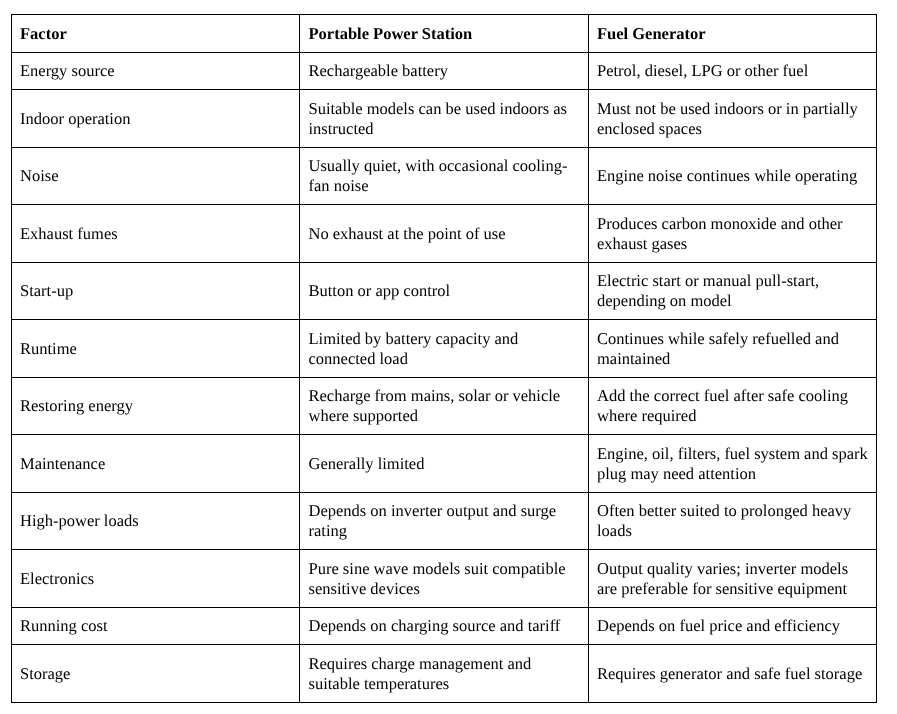
Generators have traditionally offered more continuous power for their purchase price and weight. A suitably rated generator can run power tools, pumps, heaters and several appliances for long periods, provided its running output is not exceeded. This remains a key advantage for construction, agricultural work and demanding emergency applications.
Portable power stations now cover a much wider output range than early battery units. Compact models may provide a few hundred watts, while larger systems can supply several kilowatts and scale further with compatible batteries or linked equipment. They can run refrigerators, freezers, televisions, computers, medical equipment and many cooking appliances when correctly sized.
Starting surge matters for both portable power stations and generators. Appliances containing motors or compressors, such as fridges, pumps and power tools, can briefly require several times their normal running wattage when starting up. Always check the continuous output, surge capacity and combined power requirements of connected appliances. Some portable power stations also offer special high-power modes designed to operate compatible appliances beyond their normal output rating, but these should not be confused with genuine continuous or surge power capacity.
Understanding battery capacity is essential when choosing a portable power station that can meet your energy needs. Our Complete Guide To Portable Power Stations explains how to figure out your power requirements, compare battery capacities and estimate runtimes based on appliance wattage, helping you select a suitable model for your needs.
A generator can usually run longer without an external electricity source because fuel can be added as needed. Its operating time is limited by tank size, fuel availability, duty cycle, servicing requirements and safe refuelling procedures. Some models are not designed for uninterrupted operation, so manufacturer limits still apply.
A portable power station runs until its usable battery energy is depleted. Runtime can be estimated by dividing usable watt-hours by average load in watts. For example, a 1,024Wh battery with an assumed 85% usable AC energy provides about 870Wh. A constant 100W load would therefore run for approximately 8.7 hours under those assumptions.
Real performance varies because inverter losses, standby consumption, temperature, battery condition and changing appliance demand all affect runtime. Compatible expansion batteries can extend operation, while solar or vehicle charging may restore energy during use. A power station can be more efficient for light, intermittent loads because a generator may consume fuel simply to keep its engine running.
A portable power station is substantially quieter because it has no combustion engine. Low-power operation may be almost silent, although internal fans can activate during heavy discharge or rapid charging. This makes battery power particularly suitable for homes at night, campsites, motorhomes, shared workspaces and noise-sensitive locations.
Generators create continuous mechanical and exhaust noise. Enclosed inverter generators are often quieter than open-frame models, but they remain clearly audible. Published decibel ratings should be compared carefully because test distance, load and operating mode may differ between manufacturers.
Placing a generator farther away can reduce perceived noise but must never compromise cable safety or allow exhaust to drift towards doors, windows, tents or neighbouring buildings. Local restrictions and campsite rules may also limit when a generator can operate.
A correctly operated portable power station avoids the carbon monoxide, flammable fuel and hot exhaust hazards associated with a combustion engine. It can be positioned indoors where it remains dry, ventilated and within the manufacturer's temperature limits. Integrated battery management systems commonly protect against excessive current, voltage, temperature and short circuits.
Battery systems are not risk-free. Damaged cables, unsuitable extensions, water ingress, blocked vents and overloading can create electrical or thermal hazards. Use approved charging equipment, inspect the unit before use and do not operate or charge a damaged battery. Follow the manufacturer’s instructions for storage, transport and disposal.
A fuel generator requires much stricter siting. The Health and Safety Executive warns that petrol-powered equipment can create dangerous levels of carbon monoxide within minutes indoors or in enclosed spaces. A generator must be outside in a well-ventilated position where fumes cannot gather or drift through openings. It must also be protected from rain and standing water without enclosing it.
Never connect either device directly to a household wall socket to feed power backwards into the property. Supplying fixed circuits requires suitable changeover equipment and installation by a competent professional. Improvised backfeeding can endanger occupants, utility workers and equipment.
Generators often cost less initially for a given continuous output, particularly when comparing high-powered equipment. However, purchase price is only one part of the calculation. Fuel, oil, replacement filters, servicing and safe storage add ongoing costs, and an engine can be inefficient when powering a small load well below its rating.
Portable power stations can have a higher upfront cost because the battery is the energy store as well as part of the power system. Routine operating costs are generally lower, especially when charging on a suitable off-peak electricity tariff or using existing solar generation. The battery will gradually lose capacity over time and may eventually require replacement.
The cheaper lifetime option depends on usage. A generator used only for rare emergencies may have a low purchase cost but still needs maintenance and fresh usable fuel. A power station used for camping, home backup, mobile work and tariff charging can deliver value more frequently, although adding high-capacity batteries or solar panels increases the initial investment.
A portable power station generally needs less attention. Owners should keep the battery within the recommended state of charge, store it at an appropriate temperature, update firmware where relevant and inspect cables and ports. There is no engine oil, spark plug or fuel system to service.
A generator has moving engine components and requires maintenance according to its schedule. Typical tasks may include checking or changing oil, cleaning or replacing air filters, inspecting spark plugs and managing stored fuel. Old petrol can deteriorate and cause starting or fuel-system problems, while diesel and LPG systems have their own requirements.
Generators should be test-run as instructed rather than assumed to work after years in storage. A portable power station should also be checked and recharged periodically. Emergency equipment is only useful when its condition and available energy are known before it is needed.

Small portable power stations can be carried with one hand and stored in a cupboard, car or campervan. Larger units may include wheels or suitcase-style handles, while modular batteries can divide the total weight between separate components. There is no separate fuel container to transport.
Generators can be heavy for their output and may contain residual fuel or oil. Transport must account for leaks, ventilation, hot surfaces and the manufacturer's orientation requirements. Fuel must be carried and stored in suitable approved containers away from ignition sources and living areas.
Weight should be compared alongside usable energy and output rather than in isolation. A very light battery unit may be excellent for phones and laptops but unable to run a kettle or power tool. The best portable design is the one that can be moved safely while still meeting the intended load.
A portable power station produces no exhaust emissions at the point of use. When charged from renewable electricity, it can provide low-carbon energy during operation. Solar charging also offers a practical way to replenish the battery away from the grid without burning fuel.
Its total environmental impact is not zero. Manufacturing batteries and electronics requires raw materials and energy, while charging from the grid reflects the electricity generation mix at that time. A durable LiFePO₄ battery with thousands of cycles can spread this manufacturing impact across many years of use.
A generator burns fuel whenever it runs, producing carbon dioxide and local air pollutants. Actual emissions depend on fuel, engine efficiency, load and maintenance. Running an oversized generator at a very light load can be particularly inefficient, while using a battery for smaller loads may avoid hours of unnecessary engine operation.
For most short and medium domestic power cuts, a portable power station is usually the better option. It can safely power selected indoor essentials such as routers, phones, computers, lighting and compatible refrigeration without engine noise or stored fuel. Models with UPS functionality can transfer supported equipment to battery power automatically when the mains supply fails.
Capacity determines how long the backup lasts. A compact unit may support communications and lighting, while a 1kWh to 2kWh model can run a broader group of appliances. Expandable systems provide greater resilience when outages may continue overnight or when refrigerators, freezers and pumps must remain available.
A generator may be more appropriate for a prolonged outage involving sustained high loads and no dependable recharging source. It must remain outdoors, and safe fuel storage, weather protection, extension leads and carbon monoxide risks need careful planning. For many households, a large power station supported by solar or occasional generator charging offers a more flexible compromise.
A portable power station is normally better for camping because it is quiet, compact and produces no exhaust fumes at the point of use. It can charge phones, cameras and laptops, operate compatible fridges and lighting, and be recharged from a vehicle or solar panel. Your campsite neighbours are also less likely to be disturbed.
A generator may suit remote, vehicle-based camps where high-power equipment must operate for extended periods, but many campsites restrict or prohibit generator use. It must never be run inside a tent, awning, caravan, motorhome or other enclosed or partially enclosed space as exhaust can drift into sleeping areas, even when the unit is outside but positioned poorly.
For lightweight camping, a DC power station may be enough for USB and 12V equipment. Campers needing standard plug-in appliances should choose a pure sine wave AC model with suitable output. Battery capacity, weight and available charging methods should be balanced against trip length.
A generator remains a strong choice for demanding corded tools, compressors and pumps that need high continuous output throughout a working day. Refuelling can restore operating time quickly, and rugged site generators are designed around heavy-duty use. Noise, exhaust, fuel handling and electrical protection remain important considerations.
A high-output power station can be better for indoor work, occupied buildings and locations with noise or emissions restrictions. It starts instantly, requires little maintenance and can operate low or intermittent loads efficiently. Sensitive test equipment, computers and chargers may also benefit from a pure sine wave inverter.
Check the start-up demand of every motorised tool and ensure the supply is suitable for the work environment. Commercial and construction use may involve additional electrical safety requirements, inspections or site rules beyond those applying to domestic equipment.
Yes, some portable power stations at Eco Wizard can be charged up from a compatible generator. This allows the generator to run for a shorter, more efficient period while replenishing the battery. The generator can then be switched off and the power station used silently for lighter loads, overnight operation or indoor equipment.
The charging input must be compatible with the generator's voltage, frequency and output quality. Some power stations may reject unstable generator power, and fast-charging input can place a substantial load on a small generator. Check the instructions for both products before connecting them.
Solar panels can serve a similar supporting role without fuel, although generation is weather-dependent. A hybrid backup plan can combine mains charging, solar, vehicle input and generator charging to reduce reliance on any single source.
No. A portable power station stores previously generated electricity in a battery, while a conventional generator produces electricity by burning fuel in an engine. The term solar generator is sometimes used for a power station supplied with solar panels, but the battery unit itself stores and converts energy rather than generating sunlight.
It can replace a generator for many household, camping and mobile-work applications when its output and capacity meet the load. It may not replace one for continuous high-power operation or an extended outage without a way to recharge.
Suitable portable power stations can be used indoors because they do not produce combustion exhaust. They must still be kept dry, ventilated and within the manufacturer's operating limits. Fuel generators must not be used indoors or in partially enclosed spaces.
It often is for light or moderate loads, particularly when charged using off-peak grid electricity or solar generation. The actual comparison depends on electricity tariffs, fuel prices, charging losses, generator efficiency and how frequently the equipment is used.
Runtime depends on battery capacity and connected load. Battery lifespan is measured separately in charge cycles and years. Modern LiFePO₄ units may be rated for thousands of cycles before falling to a specified percentage of original capacity.
Some generators can charge compatible power stations through their AC input. Output quality, voltage, frequency and available wattage must meet the power station's requirements. Always check both manufacturers' instructions.
A solar-charged power station is quieter, cleaner at the point of use and easier to maintain, but solar recharging depends on sunlight and panel capacity. A fuel generator offers more predictable energy in poor weather if fuel remains available, but brings noise, emissions and safety requirements.
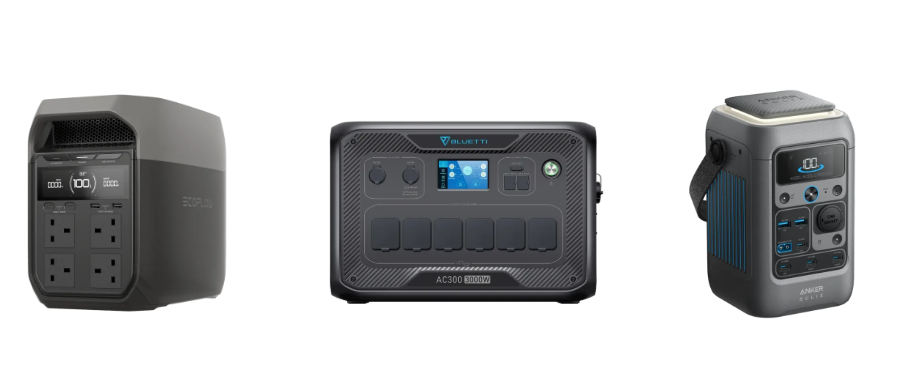
Choose a portable power station if you prioritise quiet indoor backup, simple operation, low maintenance and flexible charging. Portable units are the stronger all-round option for most homes, camping trips, motorhomes, electronics and short-to-medium outages. Select enough continuous output for the connected appliances and enough capacity for the required runtime.
Choose a generator if you need sustained high power, rapid refuelling or extended operation where recharging a battery is simply impractical. Plan for safe outdoor positioning, carbon monoxide protection, weather, fuel storage, noise and routine servicing before purchase.
Where the consequences of losing power are significant, a combined system may offer the greatest resilience. A portable power station can handle essential indoor loads quietly, while compatible solar panels or a correctly operated generator restores its battery. The best solution is the one sized around the equipment you genuinely need to run, the time it must operate and the environment in which the system will be used.
Looking for more advice? Explore our Complete Guide To Portable Power Stations at Eco Wizard today. Get a closer look at battery capacities, power outputs, charging options and smart features you need for reliable backup power. You can then browse our Portable Power Stations range to find the right solution for your home, emergency or upcoming adventure.
Power output, runtime, charging performance and fuel consumption vary by model, load and operating conditions. Never operate a fuel generator indoors or in a partially enclosed space, including a garage, shed, tent, awning, caravan or motorhome. Follow all manufacturer instructions and use a competent professional for any connection to fixed household wiring.


